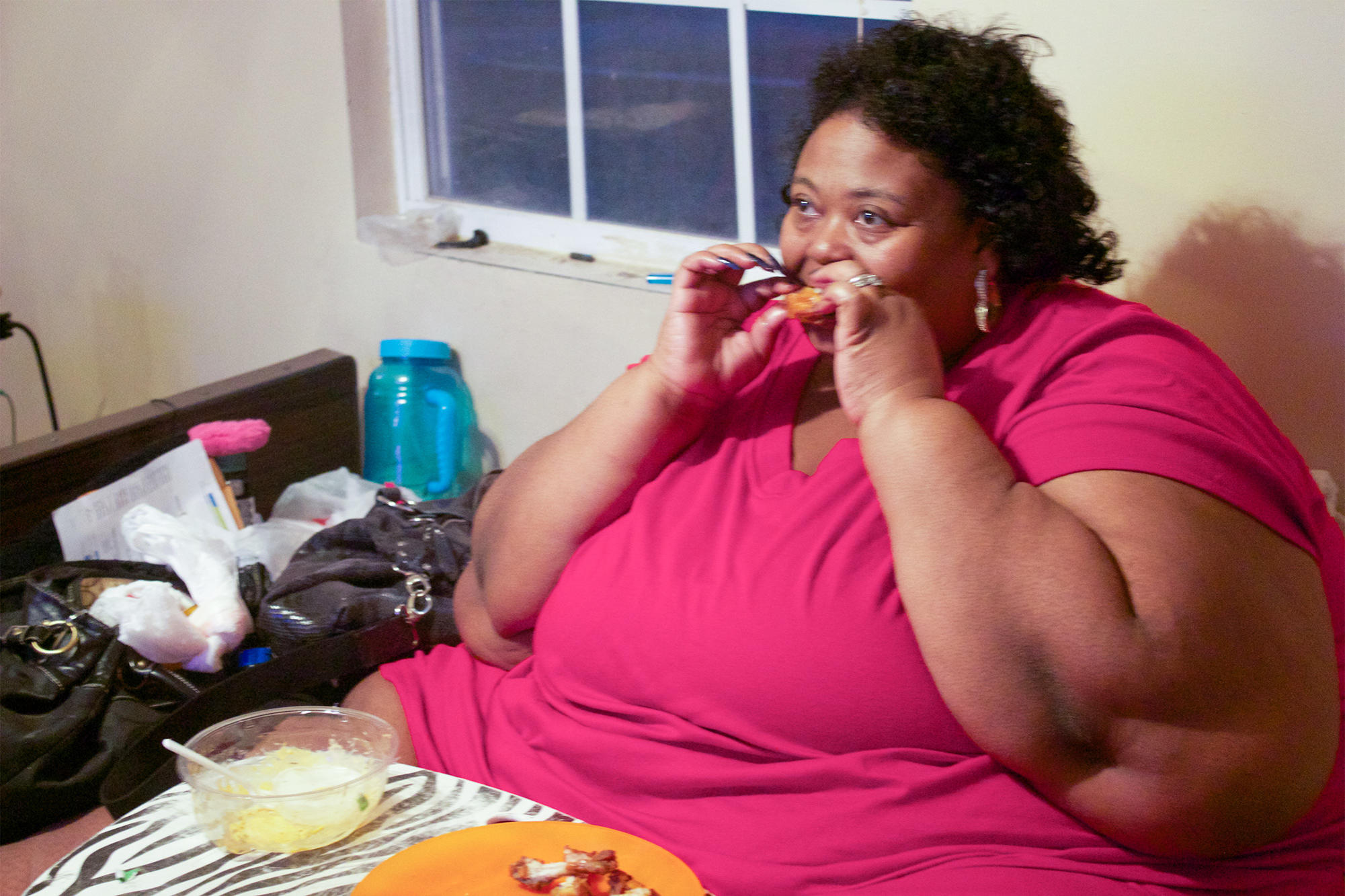
An examination of a world colored by food addiction and its outward manifestation, morbid obesity. A soul destroying world filled with obsessive thoughts, mind-numbing fantasies, and pain, mental and physical. But there is recovery in the 12 steps. I'm living it.
Saying a prayer of gratitude for the gift of recovery today, and sending a healing prayer to this woman and everyone else who is trapped in the hell that is food addiction.
The highest weight I saw on a scale was 400 pounds. I hadn't weighed myself for years, and the typical bathroom scales back then (around 2000) only displayed weights up to 300 pounds. I was obviously over that. But I needed to know how much I weighed because I felt that if I saw the numbers, it would shock me into taking action. My opportunity to see the numbers came. One day I was in grocery shopping in Safeway, and I went to the ladies room. On my way there, I saw a huge scale that I assumed the store's butchers used to weigh huge pieces of meat that was brought in from their wholesalers. It was a digital scale. After looking around to see if anyone was nearby, I stepped on it. The LED display briefly flashed at 400 pounds, and I very quickly stepped down. Then I left as fast as I could. Looking back, I can't believe the amount of emotional pain and worry I caused my family. There are no words to describe the amount of regret that I have about that. But the best thing I can do is continue to recover and work on accepting that I can nothing do change the past, but I can do a lot to make sure that I am living in recovery today. Just for today. I don't know about tomorrow; it isn't here yet. But just for today, I have a program, and I will work it to the best of my ability. Thank you, God. Food Addicts In Recovery
I'm in a 12 step program for food addiction, and most of the people come in with anywhere from 40 - 100 pounds excess fat that they often say is the result of eating "a ton" of sugar. For those of you who don't know, the word "sugar" is used in the food addiction recovery meetings to indicate food like candy, cakes, pies, donuts, cookies, ice cream--you know, the sweet stuff. Now, I'm not averse to eating sweets myself, but only after I have had what my family called "real food", which was usually high fat protein (steak, fried chicken or pork chops, homemade hamburgers or meatloaf), LOTS of bread slathered in butter and some kind vegetables as a side dish. Then it was dessert. Snacks could be anything from a soup bowl filled with cereal and milk or a hot link sandwich with mustard, mayonnaise, ketchup and hot sauce. Oh, you thought I meant potato chips or popcorn for a snack? Yes, but that stuff was usually paired with the hot link sandwich. And I topped it all off with cookies and milk. THAT, my friends, is how a person eats their way into a 400+ pound body by age 40. By the grace of God, I don't eat like that anymore. It's truly a miracle, but I have to remember that it's a one day at a time issue. I can't afford to forget that I am a real hardcore, self destructive food addict who, without the help of a Higher Power Who I don't really understand (but pray and ask for help with this addiction all the time), and the food addiction recovery program, my family would have buried me a long time ago.
Here's some food related stories and videos that I recently found. Please read the Huffington Post story that I've posted, and watch the Jamie Oliver video that's posted below that. By the way, I was more than appalled that even though the kids in the video knew that those chicken nuggets contained ingredients that they all said "EWWWW!" and scrunched up their noses at when Jamie showed them what goes into the nuggets, when Jamie asked them if they wanted to eat any, they all raised their hands and said "yes". Why? "Because we're hungry!" Wow. Nice, Madison Avenue. You've effectively brain-snatched America's kids.
I nearly fainted one day when a young mom with a toddler in a stroller asked her little one "Do you want Wendy's or Taco Bell for dinner?" I saw another one giving her infant some Fanta orange soda one day. The child couldn't have been older than six months. That's like shooting diabetes into your child's veins! I kept my mouth shut, but I was screaming inside. In my opinion, this what mass marketing does--encourage people to become zombie consumers. The messages to buy that garbage are so persuasive that there isn't much resistance to keeping large quantities of it in their homes. My parents didn't feed me that stuff all the time; they did everything they could to limit my portion sizes, encourage me to eat all my vegetables (which I HATED), and stop me from drinking more than one soda a day.
It bears mentioning that the sugar content for sodas was different back in 60s because the soft drink companies used cane sugar instead high fructose corn syrup. Cane sugar still creates "sugar cravings" and metabolizes the same way in the body, but there's something about HFCS that seems to cause people to pack on the pounds faster and put them into hard core sugar addict mode. One example: when school districts were voting to take HFCS sweetened sodas out of their vending machines back in the late 90s/early 2000, a very obese teenaged girl who was being interviewed by a local Sacramento (CA) news station claimed that she was going to stop coming to school if they got rid of the sweet stuff because she HAD to have her sodas. (Unfortunately, I can't locate that news story, but I believe it was done by either KCRA Channel 3 or Channel 10 in Sacramento.)
However, I think I was one of those kids who was genetically predisposed to food addiction. There's nothing my mother and father could have done to prevent me from being a food addict, and they spent a lot of money trying. No amount of diets, nutritional consults with doctors, hypnotherapy or even locking up the refrigerator worked for long. I became a sneak, creeping into the kitchen to get another slice of my mother's meat loaf for a sandwich, or grab a bowl of her amazing (and VERY rich) homemade macaroni and cheese. My mom would yell, "Get out of the kitchen, now! You've had enough to eat!", but that didn't stop me from coming back when she was busy doing something else. I learned to wait until she was caught up with arguing with my father, which usually happened as soon as he walked through the front door. Yes, there was a connection. But that's a whole 'nother story.
Families these days are at an even greater disadvantage when it comes to trying to preventing food addiction and childhood obesity. We didn't have the overwheming sensory overload of food commericials or the abundance of high fructose corn syrup and chemically additives in food like we did now. Couple that with the fact that many parents grew up eating even more of that non-nutritional junk than I did, add that with the fact that they never learned to cook well balanced meals for themselves, you have the perfect recipe for childhood (and adult) obesity. A lot of parents probably don't realize this, but they are potentially taking 10-15 years off their kids' life span by feeding them all that junk. Unless they make a very determined effort to provide very nutritious meals with no processed ingredients in them, their children stand a good chance of developing nutritional deficiencies that could lead to obesity at an early age.
That's why I don't let my grandson watch television (and feed him the same food I eat), and I insisted on unleashing my critical analysis of food (and toy) commericials when my three children were growing up. Of course, they didn't appreciate it at the time. ("Mom, can we just watch T.V.?!!") But they know how to keep away from the Kool-Aid as adults, and I'm taking credit for that. :) Yes, they wanted to eat the junk food like all the other kids, and I did give in sometimes. But none of them had the horrendous problems with obesity like I did growing up. And I'm very grateful for that.
I saw this post...um, somewhere. My brain hasn't been holding on to much information lately, as far as remembering things is concerned. This disturbs me, but that will probably be the subject of another blog. If I remember to write it, of course. (Oh, wait, now I remember! I get email notifications from the web service UpWorthy, then I watched it on YouTube.) Anyway, I had several flashbacks when I saw this story. I had to go through bullying in elementary school, but it was primarily about the color of my skin. A few kids teased me about my weight, which was 135 pounds by the time I was 9 years old. I was also five feet, four inches tall, considerably taller than most of my classmates at the time. Actually, I was harassed more for the color of my skin than my weight, which is something I discussed on my other blog, "Yeah...and so, anyway...", which was inspired by the 50th anniversary of the March On Washington. Basically, I didn't have to go through the same type of abuse that this dear child has to endure because I was very, very good with my fists. It's a shame she has to go through all that.
But it's wonderful how passionate her adorable twin brother is about protecting her. I was very touched by this story. But I wish she didn't have to deal with that horrific bullying issue. I understand how deeply words can hurt when you are only a child. It's so ugly, and depressing how cruel other children can be. There's no reason or excuse for that unacceptable behavior, either. Don't get me started. I've had to fight my way out of several bullying episodes, and after all these years, I can definitely tell you that it isn't the pain from punches that I remember so vividly. It's the words. Forget "sticks and stones can break my bones, but words can never hurt me". That's not how I experienced bullying, and apparently, this little girl doesn't either. I can't remember any of the punches that the bullies managed to land, but I can tell you every single derogatory term that they called me. It's not that it has an emotional charge on it anymore because all that happened in the 60s and 70s, and I look back at all that as experiences that have made me emboldened and strengthened me as far as going out into the world and dealing with people and situations. What disturbs me is how nasty the bullies have become these days. It's deplorable. How do these children learn to be so vicious? Is it television, the music or the video games like some people like to claim? Or is it something else? I hate to say this, but even in the post Brown vs. The Board of Education era that I grew up in, I didn't have to put up with the daily torment the young people have to contend with these days. And my siblings and I were often the only black kids in the school.
The planet healer in me wants to reach out to her and her mother, and share with them about what I've been through so they know that other people have faced bullying, and conquered it. I'm not proud that I had to fight my way out of those situations because the bullies thought physical confrontations would frighten me into be as submissive as a toy poodle trained to do somersaults on command. But it worked. They learned that I was not the one to play with, and that it was very prudent to leave me the hell alone. That discovery on their part, and the subsequent reputation I gained as hard hitter followed me all the way from elementary school to graduation from high school. Unfortunately, I don't think that's a viable solution for this young lady and her family. These are very different days, and I think she would find herself in a lot more trouble if she ever turned physical on her tormentors.
I wish I could sit down and have a private conversation with her mother. I know what she's going through with being a single parent, trying to deal with raising her children, work, and the on-going pain of being obese. I don't know if the mother is a food addict, but if she is, it could be that her daughter has also picked up the tool of numbing the pain of daily life with food. In my experience, very little good comes from being obese and using food as a drug to get through life. It's a pretty miserable way of living. But since I have no idea how to get in touch with them, I'll take the next right action--pray for her and her children to be free of that abusive behavior, and that the bullies learn a very memorable lesson about the very negative consequences of their behavior.
There's a positive side to this story, however--the young lady (whose name I can't remember) had how much her mother and twin brother love her, and she was serenaded by the boy band "Big Time Rush". I've seen them on Nickelodeon a few times over the past three years while I was waiting for a cartoon to come on. (Yes, I love cartoons and comic books--I'm a SERIOUS tomboy/geek girl!) The band sang a beautiful a cappella song (They can SANG!) appreciatively well during the Good Morning America broadcast for their very excited fan. I'm sure she will remember that for the rest of her life!
FORMER "BIGGEST LOSER" CONTESTANT BEING SUED OVER WEIGHT GAIN
All right, I shouted the headline with all caps too. Bad writer, bad, bad writer (slap). I've never been a fan of "reality" television shows since they have been gained a stronghold in American pop culture by exploiting what is inherent in every single one of us who is a member of the genus and subspecies Homo sapiens sapiens: character defects. None of us have been spared from having these, in fact, I say that it our journey in life to discover what they are and, over a lifetime, dispell them by any means necessary. It's hubris for some people to think that they are the fortunate ones who are inhumanly perfect, and have the indisputable right to judge, ridicule and cast aspersions on the hapless lots baring their personality warts before millions of people. Yes, it's so easy to do from the comfort of one's living room couch. I haven't been a fan since the first season of MTV's "The Real World" aired, which I watched with my then teenaged children. After two seasons, I started going back to my bedroom for my beloved reading time, which my children interrupted with "Real World" updates during commercials. But that was enough for me. Little did I know that the barometer of "reality" shows was about to dip far below what I consider the lowest point on the debauchery scale. And even worse, people would eagerly sign up to be humilitated in front of their peers on a weekly basis. I'm sure money has a lot to do with it. During an economic downturn, people become willing to do anything, a point that I feel was very aptly made in the Sydney Pollack disturbing 1969 movie, They Shoot Horses, Don't They?Altough it is not a reality show, it demonstrates how hopeless people can be easily manipulated into debasing themselves for the entertainment of others.
Now, I don't know if "Biggest Loser" star Tara Costa was hopeless when she joined the reality show cast. Moreover, I don't know if the producers consider their show to be debasing. I wouldn't know; I've never watched it and I never will. However several media sources have been reporting that Ms. Costa apparently lost a lot of weight and, as that infamous web site TMZ has declared, "...if re-gaining a bunch of weight wasn't bad enough, former "Biggest Loser" star Tara Costa is now being SUED for porking up again." Porking up, huh? Yeah, that's really clever "journalism", folks. (Don't get me started on the current state of my once beloved profession; that's a topic for a different blog.) However, if Ms. Costa is a person like me, a food addict, then it was only a matter of time before the pounds would start coming back on. In fact, it won't matter how many Iron Man triathalons she runs, how many laps she swims or miles she cycles--it will never be enough to stop IF she has what I call "The Beast" pounding away at the sensible parts of her brain like I do. Furthermore, I don't know her and I can't rightfully refer to her as a food addict like me. Now, for the logical question: what is a food addict? I can waste a lot of time describing what it is, but Dr. William D. Silkworth, author of the article "The Doctor's Opinion" that is included in the book "Alcoholics Anonymous", does a much better job of describing the addiction process than I can:
We believe, and so suggested a few years ago, that the action of alcohol on these chronic alcoholics is a manifestation of an allergy; that the phenomenon of craving is limited to this class and never occurs in the average temperate drinker. These allergic types can never safely use alcohol in any form at all; and once having formed the habit and found they cannot break it, once having lost their self-confidence, their reliance upon things human, their problems pile up on them and become astonishingly difficult to solve.
Now, if you substitute the words "flour, sugar and excess portions of food" for "alcohol", and "food addicts" for "alcoholics", the meaning and implication of the above quotation will make more sense. Hence: "...the action of flour, sugar and excess portions of food on these chronic food addicts is a manifestation of an allergy: that the phenomenon of craving is limited to this class and never occurs in the average temperate eater."
What does that mean? For the food addict, eating flour, sugar, and excess portions of food creates this disturbance in the brain in which the addict keeps eating, and eating, and eating, even when the actual physical hunger has long ceased, and the stomach is so packed with food that it becomes painfully distended. Now, normal eaters do this from time to time during special occasions such as holidays, birthday, wedding and retirement parties, travel cruises...many people do "I can't believe I ate the WHOLE THING" scenario at different times in life. Dr. Silkworth would call those people "temperate eaters". But chronic food addicts do this kind of eating on a daily basis, even when they are watching themselves go back for more, and a part of their conscious minds screams out, "NO! What are you doing? You're going to eat yourself to death; you can't possibly fit anymore food in your stomach!" Yet, to their own horror, he or she fills up another plate, or stands at the refrigerator or stove eating out of cartons, containers or pots and pans until passing out, much like an alcoholic does. This uncontrollable behavior is the result of what Dr. Silkworth describes as "the phenomenon of craving":
I do not hold with those who believe that alcoholism is entirely a problem of mental control. I have had many men who had, for example, worked a period of months on some problem or business deal which was to be settled on a certain date, favorably to them. They took a drink a day or so prior to the date, and then the phenomenon of craving at once became paramount to all other interests so that the important appointment was not met. These men were not drinking to escape; they were drinking to overcome a craving beyond their mental control. There are many situations which arise out of the phenomenon of craving which cause men to make the supreme sacrifice rather than continue to fight. (From the book, Alcoholics Anonymous, "The Doctor's Opinion")
How many times has a person who is fat/obese or morbidly obese been told to "have some will power" or "self discipline"? Or, "I know the PERFECT diet for you; my cousin/best friend/coworker lost 85 pounds in three months!" And the overweight person tries these methods, and sometimes they work--for a short period of time. They lose 85 pounds, then to their dismay, gain 100 pounds back within six months or a year. What happened? Didn't they follow the dieting instructions and use all kinds of mental discipline to prevent that weight gain? Do they like being fat? All it takes is some will power; what kind of weak-willed "loser" goes through all that trouble to take off the weight, then gains it all back? What's going on here? Why can't they lose the weight and KEEP it off?
And, how many times has someone with a binge/purge disorder ate until they were in extreme pain, then "got rid" of the food through vomiting or laxatives or excess exercise (and in some cases, all three methods) because they KNEW they couldn't stop eating and dieting didn't work for them? They do this in spite of the fact that purging throws the body into extreme disarray, causing a multitude of potential health problems. Not to mention that purging really isn't an effective method of weight loss or maintenance.
IF Ms. Costa is a food addict or has a binge/purge eating disorder, I feel very badly for her. Unlike her, people with serious food issues can recover within the safety of a 12 step program's anonymity, and they don't have to go through the added stress and anxiety of people whose motives were to capitalize on her reality show popularity for their businesses. Sure, sure, she was a willing participant and received a considerable amount of money by signing that contract. However, IF she is addicted to food and had no awareness of that, there was no way she could have predicted her inevitable weight gain and, as many food addicts have experienced, the unraveling of everything she had worked so hard to create for herself in her life. Gaining weight is miserable enough, but to also watch helpless misery as your life spins out of control and all the commitments and promises you have made to yourself and others go unfulfilled? Nightmarish. On top of all that, the various news outlets have been reporting and broadcasting statements made by chief executive officer of FC Online Marketing Michael Parrella, which probably feels like someone pouring a salt and vinegar mixture into a gaping chest wound. I'm sure Mr. Parrella doesn't understand anything about food addiction or eating disorders. Even if he did, he probably wouldn't care. Just like the manager who fires the alcoholic/coke addict after repeated warnings to "get it together", his concern is the solvency of his business. And that is as it should be.
I can't help but wonder that if Ms. Costa or Mr. Parella had received some information about the devastating physical, mental and emotional effects food addiction and eating disorders can have on a person's life, that this situation could have turned out differently. Perhaps none of this would have been hashed out in the public; both parties could have met and discussed the issues involved, agreed that Ms. Costa would need some additional support, and resolved everything without the public airing of legal dirty laundry. But that doesn't satisfy the public's hunger for titillating gossip and scandals, does it? I mean, who needs to shoot horses when the entire world can read about the details of your professional and personal life crashing down around you with impunity?
“Recognizing obesity as a disease will help change the way the medical community tackles this complex issue that affects approximately one in three Americans,” AMA board member Dr. Patrice Harris said in a statement." This statement made the usual rounds on many news sites like this one and this one AND including the Today Show. Impressive, isn't it? I'm not being sarcastic, for once. Obesity has been in the news from time to time, and a lot of people have opinions about it. Unfortunately, these same people don't have many facts about the recently named disease, other than "fat people need to diet and exercise" or "push away from the table, Tubby, or even worse, "They caused it on themselves; all it takes is willpower!". (There are other caustic observations that I've read on the various websites, but they are variations of the aforementioned themes. I know all too well the physical, mental and emotional torture of morbid obesity, as I have shared on this blog. I've done way too many diets, and the inevitable failure of each one became unbearably depressing. And I tried the "fat and happy" approach to life. It didn't work for me. Not when I was doing things like sobbing in excruiating pain becuase the cartilidge in my left was completely gone, and my hip bones were grinding into each other so much that they resembled a pretzel more than a normal hip on X-rays. And I haven't even got into my back and knees, which still give me a lot of problems, even though I've taken off a total of 158 pounds (It was 230, but I'm now coming out of relapse.) I couldn't resist to responding an NPR story in which made one of those variations on the same theme comments:
Beg to differ. There's a lot of research linking the escalating rate of obesity amongst children and the proliferation of fructose corn syrup in soft drinks and many processed food. If you looked at the labels of soft drinks prior to cane and beet sugar shortage in the 70s, you would have found NO high fructose cane sugar in the ingredients.But corn syrup is easily processed and a much cheaper ingredient for the beverage industry. Obvious translation: higher profits. Same thing with snack foods, which does really good business these days. The beverage and snack food industry intentionally put ingredients in food that will appeal to the senses in a very profound way, creating a longing for their products. (NPR had a story about this not too long ago.) How many people haven't craved a Snicker's or a Pepsi when they are tired? (I've learned that a nap works much better.) That craving is precisely what the food and beverage companies are going for with their products. And young people, with their still-forming brains, are particularily vulnerable to addiction to that junk. When they grow up, do you think they'll suddenly become spectacularly healthy and fit? No. They are hooked. Even if they diet and exercise to a normal weight, the research shows that they will gain it all back within a year plus 10-20 percent more. Yes, parents have a responsiblity to monitor their children's food intake. But it doesn't make a difference if the child is hooked on Cheetos and Cherry Cokes or cocaine, as the imaging done on people's brains after eating sugary products has demonstrated. A 14 year old brain hooked on high fructose corn syrup is no different than a 14 year old brain hooked on crack, legal issues and moral judgments aside. Both kids believe they ave to have it, and they will lie, cheat and steal to get it. Ask any mother who has an obese child. She will tell you all about how all the treats she bought for a party "just vanished", according to her very overweight child. This problem runs far deeper than anyone can imagine. This decision by the AMA is a step in the right direction, in my opinion, but that's all it is. One step.
So, will this decison made by the American Medical Association make a difference in the lives of obese people? Time will tell. But I really think it will make a monumental difference in the income of the pharmacuetical companies. They have several weight loss drugs lined up, just waiting for the doctors' prescriptions.
Last week, I started reading David Sheff's book A Beautiful Boy, and his son Nic's book, We All Fall Down. I tried reading both of them at the same time, meaning, read a chapter of David's book, then a chapter of Nic's. But for some reason, I didn't want to read Nic's book. I told myself that the reason was that David's book was well researched and beautifully written. I come from the same generation, and I'm accustomed to reading the concise, descriptive style of writing the elder Sheff displays in his book. The more in-your-face, raw style of his son was jarring to me, or that's what I told myself. My first reactions to books and life situations aren't what they seem at the time. There's often something rumbling underneath the surface of my initial reaction. Usually, it's something I don't want to face.
I wish I could say that since David Sheff is from my generation and a journalist that I identified more with his story. I admire his writing and his dedication to setting the stage, providing the research that is necessary for understanding the most complex pressing social and health issue facing this country right now. And, for the sake of pride (which, as we all know, cometh before the fall), I would like to say that I belong to his group of esteemed journalists. But that would be a lie. My food addiction and extremely low self-esteem obliterated every dream I ever had of working for a major newspaper or magazine when I was younger. And, he managed to earn a living doing what he obviously loves. That would be another no for me, for the reasons stated previously. And, if that isn't enough, he lives in Marin County (California) with his wife and two children, who are Nic's step-siblings. Yes, Marin County. I don't know if I would have lived there, but if I had pursued my journalism career to the best of my ability, I probably wouldn't have lived in the high crime, low income places as consistently as I had over the past 25+ years. And I probably wouldn't be broke now. However, I still would have been an addict, so my long term effectiveness in the career of my choice would have been questionable.
Even though I am 55 years old, have been married and divorced, raised three children as a single parent and now have a grandson, I realized that I had much more in common with twenty-something Nic than his father. The reason is simple: even though David Sheff was going out of his mind with worry and doing everything he could to help his son, he doesn't appear to have the same kind of problems with addictions that his son and I have. He's human, that's for sure, and he made plenty of mistakes. But when he discovered that his son was most definitely an addict, he approached the problem in a way that most addicts wouldn't...he gathered up all the information that he possibly could, and he asked for help. Would an addict do that? Absolutely not. No matter what the particular substance or behavior any addict is into, we all share some pretty basic characteristics: denial and a lifelong membership in the I-can-take-care-of-this-myself-so-leave-me-alone club. To sum it up, addicts are people who desperately need help, but they won't get it until some catastrophe, life or mental health-threatening situation happens to them and they have to say, "All right; I give up. Help me."
And sometimes even that doesn't work. I can tell you all about that. I've been in relapse. And, I think, so can Nic Sheff. He has relapsed countless times. Here's a few quotes from his book that echo my thoughts and feelings about myself, addiction and recovery a little too much:
Page 20, paragraph 8: "Writing my book--finishing it--getting it published--that's like the one thing I have to hold on to. I mean, really, since I was, like, six years old (age four for me, and I was frustrated because I didn't know how to write the alphabet yet), my dream has been to get a book published." Nic's treatment center counselor tells him to stop trying to write and talking about writing and publishing with other clients in treatment. I remember telling sponsors that writing was the only thing I do well, and it's only thing that keeps me sane during recovery. I had a lot to learn.
On top of page 139 is the ubiquitous "your addict is in control" speech. Unlike Nic, I never said anything whenever a sponsor or another recovery fellow ran that one down for me. But inside, I was fuming. I have to give Nic kudos, at least he voiced his discontent to his treatment counselor: "I can't talk about having doubts or anything? I mean, I'm telling you, I'm genuinely freaked about this whole thing. Should I just, like pretend I'm not feeling this stuff?" I always said, "Yeah, you're right." And I still did whatever I wanted to do anyway.
I also heard, "you are not unique, you just you think you are." That really pissed me off. I don't know if it's right, but at times like that, I automatically switch into "children should be seen, not heard" mode and clam up so tight that minutes of silence goes by. What I was thinking was, "Bitch, how do you know what I think? You don't know me!" I don't think saying that to a sponsor is appropriate, however. I guess those "I" ("I feel really angry right now.") statements is better than popping off with a smart-ass remark, which I never did because my mother drilled it into my brain to "be respectful" aka, shut-up-when-folks-who-know-more-than-you-do-are-talking. Hence, the silence. Actually, at the behest of some of my recovery fellows, I did try one of those "I" statement things about how I felt on a sponsor. Her response was, "So? Feelings come and go. They don't matter. What matters in recovery is taking the next right action." All right? Recovery folks say "take the next right action" a LOT. But what does that MEAN, exactly? I need some definitions for these terms, something I can understand and hang onto. After all, I know I am a low-bottom, gutter level food ADDICT. But what I don't know is how to "do life" without flour, sugar, and excess portions of food. The problem was, when I did ask, I didn't like the response: "Pray. Make phone calls. Read the Big Book. Write, not your kind of writing (as if "my kind of writing" had the cooties), but recovery writing." Well. That's not a whole helluva a lot of fun now, is it?
On page 177, first paragraph, Nic writes, "As much as I try to just be like everyone else, I always end up leaving feeling hollowed out, fucking gutted--like I need a drink--like I must be some entirely different species from the rest of humanity. I swear, sometimes I really do wonder if I'd be better suited as a hermit living off in a cabin somewhere--away from all people and pressures and judgements and responsibilities."
Yeah. Of course, I would rather have a deep dish pizza with garlic breadsticks or some fried chicken with greens and super-buttery cornbread (even though this kind of food would make me do the "vomitus projectus" thing because of my gastric bypass surgery), but other than being addicted to a different substance, I relate to Nic's sentiments about being better off living in a cabin somewhere 100%. In fact, whenever I read about people being locked in solitary confinement, I would think, what's so bad about that? At least no one would be bothering me. And being like everyone else? Yeah, I've always been hopelessly inept at that. I don't know how to do it, even with people in my recovery groups. I know it's me and my messed up thought patterns, but it's difficult for me to come up with something to say. Someone approaching me and saying, "How are you, Angela?" completely freaks me out. Do I tell them what I think they want to hear or the truth? Like Nic, I've always opted for what I thought people wanted to hear. Life seems so much safer that way.
And finally, this little gem from the second paragraph on page 326: "My whole life I've been looking for the easy way out. It's like I've been wearing those little plastic water wings, pretending that I could swim but never actually taking the time to learn how. So here I am, twenty-four years old, and I can't even swim. The water wings are gone, and I'm sinking--I'm going down and I'm gonna die if i can't get someone to teach me how to swim."
At fifty five years old, I feel exactly the same way. Sad. But Nic pulled himself out. And others have, too. I'm going to have to swallow my pride and ask for help. I have to let someone throw me a life preserver instead of sinking by myself. And also like Nic, I need a lot of help, not only from my food addiction 12 step program, but also from mental health professionals. For people like me with "grave emotional and mental disorders", there has to be more than one source of help: God (of course), my 12 step fellowship (who I will have to learn how to trust), psychiatrists and therapists. After all, it is MY recovery, no one else's. For the very first time ever, I recognize that I need to do this, and to stop being ashamed of the fact that I do need extra help. Thanks, Nic, for sharing your story and helping me see myself reflected in your words.
Post-traumatic stress disorder (PTSD) is an anxiety disorder that some people develop after seeing or living through an event that caused or threatened serious harm or death. According to the 2005 National Comorbidity Survey-Replication study, PTSD affects about 7.7 million American adults in a given year, though the disorder can develop at any age, including childhood. Symptoms include strong and unwanted memories of the event, bad dreams, emotional numbness, intense guilt or worry, angry outbursts, feeling “on edge,” and avoiding thoughts and situations that are reminders of the trauma. National Institutes of Health report: PTSD
It was my oldest daughter who insisted that I show signs of the Post Traumatic Stress Syndrome. I scoffed at the idea. That's what my father has, and for good reasons. He's served in both Korea and Vietnam. I really didn't see it as being an issue in my life. Besides, don't I have enough "issues" already? Recovering from food addiction, in my experience, is quite enough to have to deal with. But after many up and downs in my recovery, I finally had to concede that maybesomething is going on within my mental/emotional processing that keeps causing depression, anxiety, despair and finally, the inevitable "first bite" of food that I have for years had difficulty restraining my consumption. So, I got on my computer and did the research. Unfortunately, I didn't like what I uncovered.
Since I'm a Kaiser Permanente patient (sorry, I can't link to their site; but you can go here,here or here for more information), I went to their website, read everything I could about it, and found an self-assessment form. I filled out the assessment and looked at the scoring ranges, which was: If your score is: 0 – 16 = No symptoms of PTSD. 17 – 20 = No to minimum symptoms of PTSD. 21 – 29 = Mild symptoms of PTSD. 30 – 49 = Moderate symptoms of PTSD. 50 – 86 = Severe symptoms of PTSD.
My score? 73. Pretty solidly PTSD. Who knew? I sure didn't.
Suddenly, the memories began rushing in, and even though I was extremely upset and sad by their appearance, I felt like I had finally found the missing puzzle pieces. I'm not "constitutionally incapable of being honest with (myself) themselves" , as the book "Alcoholic Anonymous" states. Nor am I looking for the "softer, easier way" to recover from food addiction. Just because I could have PTSD doesn't mean I expect special consideration, i.e., a "pass" on eating "weighed and measure meals with nothing in between, no flour, no sugar, and no excess portions" or using the tools of the program to get from one meal to the next. It simply means, as far as I'm concerned, I get counseling that focuses on decreasing the effects PTSD has had on my life, and especially, my recovery.
But what does PTSD look like if you aren't a military veteran who has been in combat situations? I don't know about anyone else, but mine began with a military veteran--my father, who had served in Korea and Vietnam.
I was fourteen years old in in the spring of 1972, and already in the point of absolutely no return as far as food addiction goes. At that time, I weighed anywhere between 210 to 220 pounds, and I was ashamed of my body and miserably depressed about my inability to stay on diet most of the time. One day, I sitting on my bed listening to my radio, and I heard my mother saying something to my father. As usual, I ignored them and continued gazing out of my window while listening to the music. My father appeared in the bedroom doorway and told me to turn the music down. Like most teenagers, I was annoyed with that directive, but I reached over to turn down the volume. Next thing I knew, something that felt like large rock struck the right side of my face, and I went flying backwards across my bed. Stunned, I looked up and saw my father glaring at me. He pointed a right index finger in my face and snarled, "You better move faster when I tell you something to do, you hear me?" I couldn't say anything. My throat closed up and I could feel the tears dripping off my chin. He had never, ever done anything like that before, and fortunately, he never did it again.
I don't remember much of what happened after that. I know I stayed in bed crying, and I wasn't allowed to go to school until the black eye had completely healed. Maybe my mother gave me an ice pack for my eye, maybe she didn't. Maybe she came in my bedroom and tried to explain my father's irrational explosion to me, maybe she didn't. All I know is that nothing was ever said about the incident. The message was unspoken, but clear. I was to act like it never happened and tell absolutely no one about it at school or anywhere else. And I didn't, until I wrote this blog forty years later.
Being addicted to food is catastrophic to one's physical and mental health, but over the years, I found it to be an excellent temporary balm to any emotional wound, including my father hitting me in a sudden fit of rage . The downside is, like drugs, alcohol, sex, gambling or shopping, it takes rapidly increasing amounts of the substance or behavior (for me, it was food like a double cheeseburgers with bacon, lettuce, tomatoes and onions, large fries and a large chocolate shake) to get that calming, drowsy relief from the mental and emotional storms that raged (and persist to this day) inside me. By the time I graduated from high school, I was stuffing down enough food to bring my weight up to 240 pounds. When I was an English major and a supposed to be a graduating senior at California State University at Sacramento, I weighed 265 pounds. I rarely showed up for my classes, and when I did, all I could do was either think about what (and where) I was going to eat as soon as I got out or I fantasized about having a boyfriend. My once honor roll grade point average dropped to 1.85, and I was on academic probation. So I left school, went on a starvation diet that made me drop 57 pounds in four months, found a job as a newspaper writer, AND...lo and behold, a boyfriend seemed to magically pop into my life. I thought I had found the answer to all of my problems. Lose weight, get a job and a man--life is good.
As that old saying goes, history has a way of repeating itself. In my case, I didn't see the signs or recognize the familiar patterns.Like many people who grew up in alcoholic families, I had no idea that I was repeating my past, and even if I had some inkling, I would have denied it. "I never saw my father hit my mother," I would have told a person who might have suggested that I was turning into a carbon copy of my mother. And that would have been an absolutely true statement. He didn't my mother. And he only hit me once. Yeah, it was pretty harsh; my eye closed and it was red, black and blue for almost two weeks, but so what? He never did it again, and that's all that matters. It's in the past.
Well, that boyfriend became my husband (now ex) and the father of my three children. I didn't know it back then, but he had, and still has, one the most maniactypes of bi-polar disorder, a heavy addiction to cocaine, marijuana, crack and sex with numerous women, and an aversion to finding and keeping suitable employment to help his growing family. Worst of all for me, he had been severely abused by an insane, autocratic step-father. No, I didn't see it coming. Repeating the past? No way! My dad not only hit me JUST that one time, but he ALWAYS worked and provided us. How could anyone say I was repeating the past? Besides, that's all over and done. I've "moved on".
During the six and one half years we were married, he slapped me numerous times, usually because I didn't respond to him "with respect", or I wasn't "paying attention" to him. It was true; I didn't respect him, or to be even more honest, like him. Pay attention to him? Please. He was a full grown adult; his "attention time" should have happened with his mother, so as far as I was concerned, his neediness was not my problem. Our children, however, were a different story. They needed to be cared for by at least one rational thinking adult. Not only that, I had a household to run with whatever money I managed to hide from him to pay the bills. He hated holding down a job (I did that most of the time), took what little money we had and spent it on drugs and all kinds of women, then expected me to be his adoring fan, no matter what he did. I found very little to respect.
(By the way, the behavior and attitude that I've described in the previous paragraph is known as "codependency". In this excerpt from the WebMD article that I've linked to, you can read what kind of codependent I was):
Still, the codependent partner often finds some type of reward in this setup. "Probably the most significant theme is a sense of control," Bochner says. "The other person plays the out-of-control person, and so the codependent partner gets to be the person who is in control and thus respected."He says the partner who is codependent can be "the better person, the smarter person, the person who's recognized as having it all together. They're defining themselves as strong enough to deal with it when actually they need to realize that maybe they should be taking care of themselves instead of proving their strength."
I won't go into detail about the physical abuse involved in that marriage because even though it has been nearly 30 years of numbing out the pain and stuffing the memories down with food, reviewing that period of my life feels very raw. But this is what happened:
1. He became angry because I had to go to a work related event, and he wanted me to stay home and cook for him. He shoved me down on the ground, grabbed the still-hot iron that I was using to iron my clothes, and held it over my face, telling me he would burn it off unless I promised to stay home.
2. After a July 4, 1981 argument, he pinned me down in the back seat of his mother's little Datsun beater, and smashed his fist into my face repeatedly. According to the x-rays, his fist came within a millimeter of crushing my temple, the doctor in ER said. He was upset and wanted me to call the police. My parents did it for me. A few days later, I entered the hospital to have reconstructive surgery on my face.
3. After another argument, he grabbed our oldest daughter, who was about 16 months old, and our son, a one month old infant, held them over the balcony of our two floor apartment and threatened to drop them. I completely broke down to the ground, crying hysterically. He told me, "You know I wasn't going to do that. You know I would never do that." He frequently said after threatening me or the children.
4. He broke down the front door after being on the run for two months with a teen-aged girl who was a foster home resident, screamed at me about how I was "keeping him away from his kids", pulled out a very long, serrated Bowie hunting knife out of his pants pocket and tried to stab me with it. I fought him off with a closet pole.
After we split up, I numbed the pain withKing Henry VIII sized portions of food, and ate my way up to 400 pounds. I'm no longer anywhere close to that weight, but I've been struggling with my recovery for almost two years now. Hopefully, with therapy and support of my 12 step friends, I will be able to "trudge the Road of Happy Destiny."
John Bradshaw - Healing The Shame That Binds You (Part 2)
I received this from a friend who is also a food addict. It's a humbling reminder of what I and so many other people are dealing with. Recently, I have been experiencing the thoughts expressed in this article (I have no idea who wrote it, but whoever it was nailed the target). This is quite frightening because I can't afford to let up on my program, especially with my health issues and history of family addictions. It's no joke. Food addiction KILLS.
I Hate meetings....I Hate higher powers. I Hate anyone who has a
program. To all who come in contact with me, I wish you death and I
wish you suffering.
Allow me to introduce myself, I am the disease of addiction,. I am cunning, baffling and powerful
Thats Me. I have killed millions and I am pleased.
I love to catch you with the element of surprise. I love pretending I am your friend and lover.
I have given you comfort haven't I? Wasn't I there when your were lonely?
When you wanted to die, didn't you call on me? I was there. I
love to make you hurt. I love to make you cry. Better yet, I love to
make you so numb you can neither hurt nor cry. When you can't feel
anything at all. This is true gratification. And all that I ask from
you is long term suffering. I've been there for you always. When
things were going right in your life, you invited me. You said you
didn't deserve these good things, and I was the only one who would agree
with you;. Together we were able to destroy all the good things in
your life. People don't take me seriously. They take strokes
seriously, heart attacks, even diabetes, they take seriously. Fools.
Without my help these things would not be possible. I am such a hated
disease, and yet I do not come uninvited. You choose to have me. So
many have chosen me over reality
and Peace.
More than you hate me I hate all of you who have a 12 step
program. Your program, Your meetings, Your higher power. All of these
things weaken me, and I can't function in the manner I am accustomed
to. Now I must lie here quietly. You don't see me but I a growing
bigger than ever. When you only exist, I may live. When you live I may
only exist. But I am here....
Now until we meet again, If we meet again, I wish you death and suffering.
It started real slow, real sneaky after I noticed that could "get away with" eating a "little bit of this" and a "little bit of that". The weight was still dropping, fast. It just kept coming off, so I thought those little bits didn't matter. But I was wrong...very, very wrong.
I'm a food addict. I need boundaries, especially with food, and moving on from there, with living my life. But before I began a program that addressed my food addiction, I didn't know how to stop eating. Let's get real here--I'm the type of gutter-level food addict who binged so bad for a 14 hour period that I ripped a hole in my stomach lining (hernia). I didn't know that at the time, of course. I was too busy eating more food. I felt something in my stomach had stretched and popped after I had been throwing all that food up (even I have limits, apparently) for four hours, but I didn't do anything about it. It didn't even occur to me to call a doctor. I was morbidly obese, somewhere over 350 pounds at the time. I knew the drill by then--go to the doctor, hear the "lose some weight and your symptoms will disappear" speech, go home feeling lower than sh*t, open the refrigerator to get something to numb that feeling. I wasn't aware that this was the pattern I had developed over the years. It was what I did, unconsciously and automatically. If I was taking a breath, I was thinking about what I was going to eat, where I would eat it, how much money it would cost (I had contingency plans in case I didn't have enough money to eat exactly what I felt like I wanted), where I would eat it...on and on.
That has been my life, day after day, month after month, year after year, decade after decade, from the time I got my first "hit" eating a half bottle of chewable vitamins at age 5 until...well, we'll see how I do today. It's all about staying in today, which is something that I'm not in the habit of doing. That's all I can handle because I'm in that emotionally agonizing infernal place of knowing that I have to work my recovery program to keep alive, but hating every second of it because it leaves me emotionally vulnerable. Like most food addicts I've talked to, I love comfort, ironically enough. I have always been very uncomfortable and revolted by the appearance of my body, even when I working my recovery diligently and I was 65 pounds thinner than I am right now. But that encompassing hatred of my body has been superseded by the irresistible need to succumb to the familiar calm and the anesthetic effect food has always had on me.
"Face your fears, get out of your comfort zone." That's what my sponsor tells me now. How do you do that when you are accustomed to reaching for some of this and that before you can answer the telephone or say hello to someone? It freaks me out, to be honest. I was calm and in charge on food, at least that's how I felt. I clearly remember that I never felt the level of anxiety on a minute by minute basis the way I do now. I don't know how people get through the work day without having a stash in your desks drawers, and taking vending machine breaks throughout the day. Maybe the rest of you have your own addiction problems that don't show up on your body the way mind do. A part of me wishes I did have one of those "hidden" addictions--you know, being addicted to relationships (and that's in spite of the fact that I'm a relationship anorexic; I'll take a down home Southern food or working on my writing over a man ANY DAY), playing video games, collecting coupons, going to comic book conventions...actually, I take back collecting coupons and playing video games. Those might not show up as pounds on the body, but I can't see myself doing them. They're way too complicated.
These are the facts: I know the food plan; I don't have to scramble around trying to figure out how to buy and fix the food the way I did when I was a newcomer. What I have do now is pray for the courage to remain abstinent from flour, sugar and excess food, call my sponsor on me, do my prayers and quiet time, call my fellow food addicts for help and write down what I'm gong to eat the next day and how I've been feeling during the day--EVERY SINGLE DAY WITHOUT FAIL, something I didn't do with any consistency in the past. It's simple enough plan for living. But it's definitely not easy. When I went on diets, I never changed my thoughts and behaviors. My recovery absolutely demands that I do both. And I have to do it, if I don't want to die If you want to know what I'm talking about, check out my previous posts about all of my health issues here . And here. And here. Oh hell, if you don't have anything better to do right now, read this here.
Whatever happened to Kenneth Brumley, also known as the "Half Ton Dad" on TLC/Discovery Health shockumentaries about morbidly obese people? Is he dead? Or if he's still alive, has he re-gained all of his weight, plus more?
I'm not a doctor, but in my years of experience as a food addict, I can tell you that unless some very DRASTIC changes took place in Kenneth's life, he had weight gain and/or death to look forward to after he left the Renaissance Hospital. I wish I could say something different, but I know how powerful food addiction is. It's way too much for any one person to handle by him or herself. Besides, Kenneth didn't have a supportive environment waiting for him at home after he was released from the hospital. Granted, the program only provided the audience with glimpses of his home life. For all we know, his girlfriend, her children, his children and grandchildren all eat lean protein, plenty of fresh veggies and fruit, and whole grains on most days. I doubt this, however. Although some of the family seemed to be of a normal weight, they were shown heartily chowing down on very high fat/calorie fast food. In the first video, Kenneth talks about eating three cheeseburgers and drinking two liters of soda. He didn't specify what kind of cheeseburger, but one Big Mac provides nearly half the calories that a healthy person should eat in one day.
Don't believe me? I'm not a dietician of course, but here's the nutritional breakdown:
My guess is that when the Big K said three cheeseburgers, he wasn't talking about the small ones that come with onions and pickles. He was talking about the BIG ONES, the triple cheeseburgers, or the "Angus" burgers that come with heaping amounts of extra stuff--extra cheese, grilled mushrooms, the proverbial lettuce, onions and tomatoes (personally, when I thought of vegetables, that is what I thought of--the stuff on top of a burger.) Yeah, you get the idea. That's what I was talking about when I said the word "cheeseburger". I could only handle one with some small fries and a medium chocolate shake. Even THAT was a helluva a lot of food, and trust me, that wasn't my only meal of the day.
This is what Angela used to eat when she went to McDonald's (pre-food addiction recovery):
Double Quarter Pounder with Cheese: 9.8 oz; 740 calories, 380 calories from fat(or 42% of the total daily amount of fat recommended for a healthy diet);
small fries: 2.5 oz; 230 calories, 100 calories from fat or 11% of the daily amount of fat (we are now over half the amount of fat that a person should have in one day)
AND one 16 fluid ounce Chocolate Triple Thick Shake: 580 calories (we are now OVER the recommended amount of calories/fat for effective weight loss for one day with this meal!); 120 calories are from fat, or 14% of the daily amount.
That's JUST one meal! And I ate three big ones every day!
So, you want an example of breakfast and dinner? Let's see...on the same day I might make a large cereal bowl of grits with LOTS of butter or margarine (Don't ask me how much; I never measured anything!) four scrambled eggs with green onions and mushrooms (scrambled with a LOTS of butter or margarine) and four pieces of whole grain, honey wheat toast with LOTS of butter or margarine. Do you see the pattern here?
For dinner I might "take it easy" and get a large bowl of creamy tomato soup, about 4-6 more slices of that honey wheat bread, and slice up a half pound of extra sharp cheddar cheese. Sometimes I would make a grilled cheese sandwich (with LOTS of butter or margarine); sometimes I would be "too tired" and just eat the bread and cheese.
I'll let you figure out the calorie count for my three meals. I am now officially depressed. And more than likely, I had ice cream or cookies and milk at some point during the day, too.
What I'm showing you, folks, is Angela's recipe for packing on 400 pounds of weight. Kenneth said he ate THREE cheeseburgers, and he thought that was eating light. Well, basically, BOTH of us are very sick food addicts, in my opinion. I was headed down the path that Kenneth was on (and perhaps still is). I pray that this isn't the case, but people being who they are, change is extremely difficult for most of us. It certainly has been for me. And I still stumble and fall back into some of my old behaviors. Thank God, nothing like how I used to eat. But if I wasn't in a program that has been helping me recover from food addiction, I wouldn't be where Kenneth is,(or was, whatever the case may be). I wouldn't have made it that far up the scale. Dead. That's where I would be. I KNOW this.
As for the second video, I included this because I thought what brotha man (Larry Cooper) said about his food summed up why I ate addictively:
This is me and MY world. I love my food; I appreciate my food. Once you eat, everything goes away, all the pain,all the misery...(Points to the various food items on his plate, but what he says is unclear at first)...everything is gonna be all right. Everything is gonna be all right. This is like "home sweet home"; it's like another dimension, "The Twilight Zone".
Yep. I hear you, Larry. I understand what you're saying, believe me. And "there by the grace of God go I..."
Post script: I searched for an update on Larry Cooper, too. Nothing, not even on the former-TLC-now-known-as-Discovery-Health channel. What's up with that, Discovery Health? Do you have any intention of providing follow up programs to see how these folks are doing? Do you even care, or are they just the perennial "circus freaks"? I think I know the answer to that.