Showing posts with label morbid obesity. Show all posts

Thursday, June 18, 2015

This would have been me

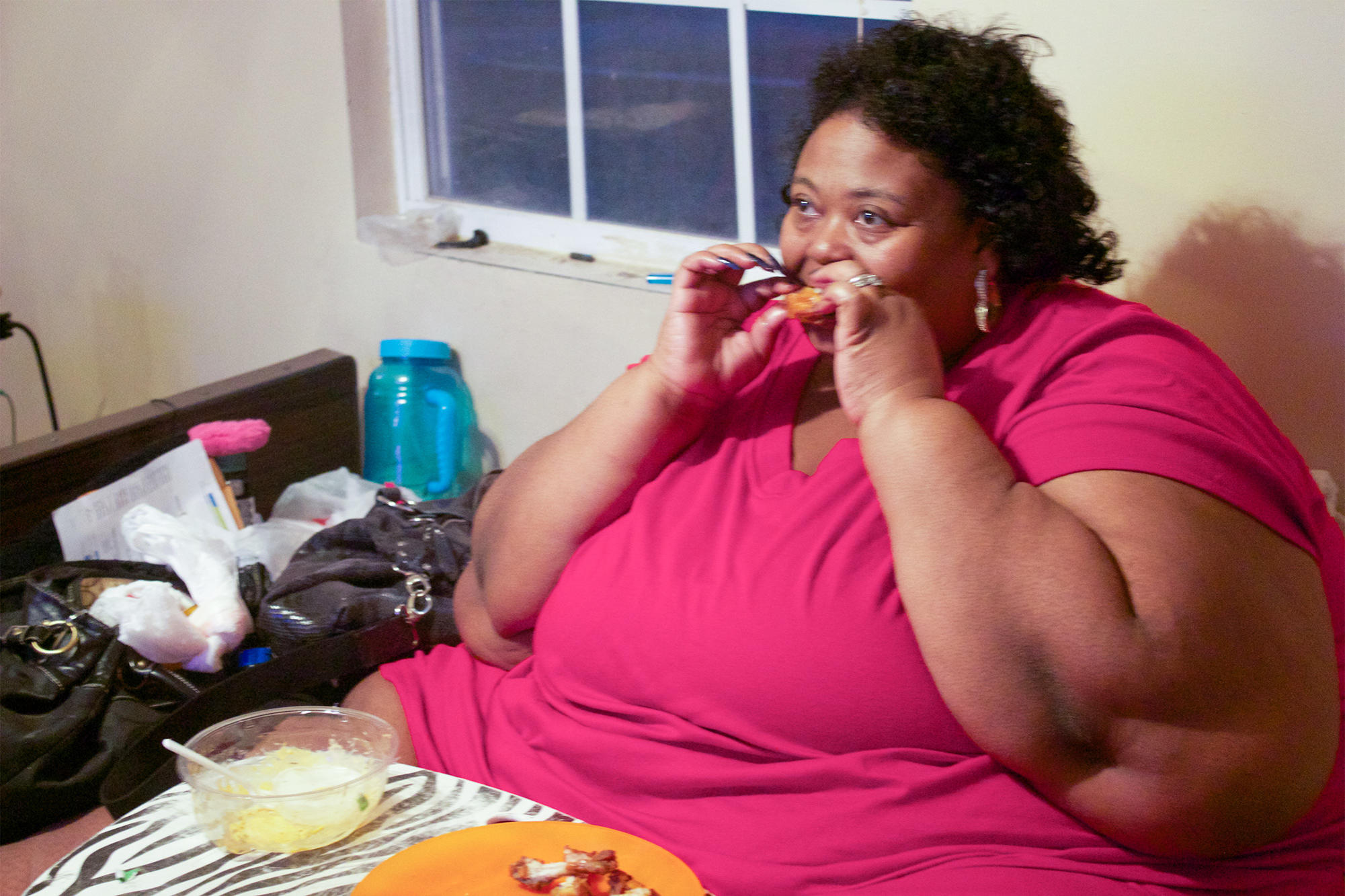
Saying a prayer of gratitude for the gift of recovery today, and sending a healing prayer to this woman and everyone else who is trapped in the hell that is food addiction.
From the TLC Channel: Marla's Journey

The highest weight I saw on a scale was 400 pounds. I hadn't weighed myself for years, and the typical bathroom scales back then (around 2000) only displayed weights up to 300 pounds. I was obviously over that. But I needed to know how much I weighed because I felt that if I saw the numbers, it would shock me into taking action. My opportunity to see the numbers came. One day I was in grocery shopping in Safeway, and I went to the ladies room. On my way there, I saw a huge scale that I assumed the store's butchers used to weigh huge pieces of meat that was brought in from their wholesalers. It was a digital scale. After looking around to see if anyone was nearby, I stepped on it. The LED display briefly flashed at 400 pounds, and I very quickly stepped down. Then I left as fast as I could. 

Looking back, I can't believe the amount of emotional pain and worry I caused my family. There are no words to describe the amount of regret that I have about that. But the best thing I can do is continue to recover and work on accepting that I can nothing do change the past, but I can do a lot to make sure that I am living in recovery today. Just for today. I don't know about tomorrow; it isn't here yet. But just for today, I have a program, and I will work it to the best of my ability. Thank you, God.

Food Addicts In Recovery

Friday, November 22, 2013

What causes someone to be morbidly obese?

I'm in a 12 step program for food addiction, and most of the people come in with anywhere from 40 - 100 pounds excess fat that they often say is the result of eating "a ton" of sugar. For those of you who don't know, the word "sugar" is used in the food addiction recovery meetings to indicate food like candy, cakes, pies, donuts, cookies, ice cream--you know, the sweet stuff. Now, I'm not averse to eating sweets myself, but only after I have had what my family called "real food", which was usually high fat protein (steak, fried chicken or pork chops, homemade hamburgers or meatloaf), LOTS of bread slathered in butter and some kind vegetables as a side dish. Then it was dessert. Snacks could be anything from a soup bowl filled with cereal and milk or a hot link sandwich with mustard, mayonnaise, ketchup and hot sauce. Oh, you thought I meant potato chips or popcorn for a snack? Yes, but that stuff was usually paired with the hot link sandwich. And I topped it all off with cookies and milk. THAT, my friends, is how a person eats their way into a 400+ pound body by age 40. By the grace of God, I don't eat like that anymore. It's truly a miracle, but I have to remember that it's a one day at a time issue. I can't afford to forget that I am a real hardcore, self destructive food addict who, without the help of a Higher Power Who I don't really understand (but pray and ask for help with this addiction all the time), and the food addiction recovery program, my family would have buried me a long time ago.

Here's some food related stories and videos that I recently found. Please read the Huffington Post story that I've posted, and watch the Jamie Oliver video that's posted below that. By the way, I was more than appalled that even though the kids in the video knew that those chicken nuggets contained ingredients that they all said "EWWWW!" and scrunched up their noses at when Jamie showed them what goes into the nuggets, when Jamie asked them if they wanted to eat any, they all raised their hands and said "yes". Why? "Because we're hungry!" Wow. Nice, Madison Avenue. You've effectively brain-snatched America's kids.

I nearly fainted one day when a young mom with a toddler in a stroller asked her little one "Do you want Wendy's or Taco Bell for dinner?" I saw another one giving her infant some Fanta orange soda one day. The child couldn't have been older than six months. That's like shooting diabetes into your child's veins! I kept my mouth shut, but I was screaming inside. In my opinion, this what mass marketing does--encourage people to become zombie consumers. The messages to buy that garbage are so persuasive that there isn't much resistance to keeping large quantities of it in their homes. My parents didn't feed me that stuff all the time; they did everything they could to limit my portion sizes, encourage me to eat all my vegetables (which I HATED), and stop me from drinking more than one soda a day.

It bears mentioning that the sugar content for sodas was different back in 60s because the soft drink companies used cane sugar instead high fructose corn syrup. Cane sugar still creates "sugar cravings" and metabolizes the same way in the body, but there's something about HFCS that seems to cause people to pack on the pounds faster and put them into hard core sugar addict mode. One example: when school districts were voting to take HFCS sweetened sodas out of their vending machines back in the late 90s/early 2000, a very obese teenaged girl who was being interviewed by a local Sacramento (CA) news station claimed that she was going to stop coming to school if they got rid of the sweet stuff because she HAD to have her sodas. (Unfortunately, I can't locate that news story, but I believe it was done by either KCRA Channel 3 or Channel 10 in Sacramento.)

However, I think I was one of those kids who was genetically predisposed to food addiction. There's nothing my mother and father could have done to prevent me from being a food addict, and they spent a lot of money trying. No amount of diets, nutritional consults with doctors, hypnotherapy or even locking up the refrigerator worked for long. I became a sneak, creeping into the kitchen to get another slice of my mother's meat loaf for a sandwich, or grab a bowl of her amazing (and VERY rich) homemade macaroni and cheese. My mom would yell, "Get out of the kitchen, now! You've had enough to eat!", but that didn't stop me from coming back when she was busy doing something else. I learned to wait until she was caught up with arguing with my father, which usually happened as soon as he walked through the front door. Yes, there was a connection. But that's a whole 'nother story.

Families these days are at an even greater disadvantage when it comes to trying to preventing food addiction and childhood obesity.  We didn't have the overwheming sensory overload of food commericials or the abundance of high fructose corn syrup and chemically additives in food like we did now. Couple that with the fact that many parents grew up eating even more of that  non-nutritional junk than I did, add that with the fact that they never learned to cook well balanced meals for themselves, you have the perfect recipe for childhood (and adult) obesity. A lot of parents probably don't realize this, but they are potentially taking 10-15 years off their kids' life span by feeding them all that junk. Unless they make a very determined effort to provide very nutritious meals with no processed ingredients in them, their children stand a good chance of developing nutritional deficiencies that could lead to obesity at an early age.

That's why I don't let my grandson watch television (and feed him the same food I eat), and I insisted on unleashing my critical analysis of food (and toy) commericials when my three children were growing up. Of course, they didn't appreciate it at the time. ("Mom, can we just watch T.V.?!!") But they know how to keep away from the Kool-Aid as adults, and I'm taking credit for that. :) Yes, they wanted to eat the junk food like all the other kids, and I did give in sometimes. But none of them had the horrendous problems with obesity like I did growing up. And I'm very grateful for that.

Fast food truths


Wednesday, June 26, 2013

Well, it's official....The American Medical Association says obesity is a disease

“Recognizing obesity as a disease will help change the way the medical community tackles this complex issue that affects approximately one in three Americans,” AMA board member Dr. Patrice Harris said in a statement." This statement made the usual rounds on many news sites like this one and this one AND including the Today Show. Impressive, isn't it? I'm not being sarcastic, for once. Obesity has been in the news from time to time, and a lot of people have opinions about it. Unfortunately, these same people don't have many facts about the recently named disease, other than "fat people need to diet and exercise" or "push away from the table, Tubby, or even worse, "They caused it on themselves; all it takes is willpower!". (There are other caustic observations that I've read on the various websites, but they are variations of the aforementioned themes. 

I know all too well the physical, mental and emotional torture of morbid obesity, as I have shared on this blog. I've done way too many diets, and the inevitable failure of each one became unbearably depressing. And I tried the "fat and happy" approach to life. It didn't work for me. Not when I was doing things like sobbing in excruiating pain becuase the cartilidge in my left was completely gone, and my hip bones were grinding into each other so much that they resembled a pretzel more than a normal hip on X-rays. And I haven't even got into my back and knees, which still give me a lot of problems, even though I've taken off a total of 158 pounds (It was 230, but I'm now coming out of relapse.) I couldn't resist to responding an NPR story in which made one of those variations on the same theme comments:
Beg to differ. There's a lot of research linking the escalating rate of obesity amongst children and the proliferation of fructose corn syrup in soft drinks and many processed food. If you looked at the labels of soft drinks prior to cane and beet sugar shortage in the 70s, you would have found NO high fructose cane sugar in the ingredients.But corn syrup is easily processed and a much cheaper ingredient for the beverage industry. Obvious translation: higher profits. Same thing with snack foods, which does really good business these days. The beverage and snack food industry intentionally put ingredients in food that will appeal to the senses in a very profound way, creating a longing for their products. (NPR had a story about this not too long ago.) How many people haven't craved a Snicker's or a Pepsi when they are tired? (I've learned that a nap works much better.) That craving is precisely what the food and beverage companies are going for with their products. And young people, with their still-forming brains, are particularily vulnerable to addiction to that junk. When they grow up, do you think they'll suddenly become spectacularly healthy and fit? No. They are hooked. Even if they diet and exercise to a normal weight, the research shows that they will gain it all back within a year plus 10-20 percent more. Yes, parents have a responsiblity to monitor their children's food intake. But it doesn't make a difference if the child is hooked on Cheetos and Cherry Cokes or cocaine, as the imaging done on people's brains after eating sugary products has demonstrated. A 14 year old brain hooked on high fructose corn syrup is no different than a 14 year old brain hooked on crack, legal issues and moral judgments aside. Both kids believe they ave to have it, and they will lie, cheat and steal to get it. Ask any mother who has an obese child. She will tell you all about how all the treats she bought for a party "just vanished", according to her very overweight child. This problem runs far deeper than anyone can imagine. This decision by the AMA is a step in the right direction, in my opinion, but that's all it is. One step.

So, will this decison made by the American Medical Association make a difference in the lives of obese people? Time will tell. But I really think it will make a monumental difference in the income of the pharmacuetical companies. They have several weight loss drugs lined up, just waiting for the doctors' prescriptions. 

Monday, May 30, 2011

Wondering about "Half Ton Dad"


Whatever happened to Kenneth Brumley, also known as the "Half Ton Dad" on TLC/Discovery Health shockumentaries about morbidly obese people? Is he dead? Or if he's still alive, has he re-gained all of his weight, plus more?

I'm not a doctor, but in my years of experience as a food addict, I can tell you that unless some very DRASTIC changes took place in Kenneth's life, he had weight gain and/or death to look forward to after he left the Renaissance Hospital. I wish I could say something different, but I know how powerful food addiction is. It's way too much for any one person to handle by him or herself. Besides, Kenneth didn't have a supportive environment waiting for him at home after he was released from the hospital. Granted, the program only provided the audience with glimpses of his home life. For all we know, his girlfriend, her children, his children and grandchildren all eat lean protein, plenty of fresh veggies and fruit, and whole grains on most days. I doubt this, however. Although some of the family seemed to be of a normal weight, they were shown heartily chowing down on very high fat/calorie fast food. In the first video, Kenneth talks about eating three cheeseburgers and drinking two liters of soda. He didn't specify what kind of cheeseburger, but one Big Mac provides nearly half the calories that a healthy person should eat in one day.

Don't believe me? I'm not a dietician of course, but here's the nutritional breakdown:

My guess is that when the Big K said three cheeseburgers, he wasn't talking about the small ones that come with onions and pickles. He was talking about the BIG ONES, the triple cheeseburgers, or the "Angus" burgers that come with heaping amounts of extra stuff--extra cheese, grilled mushrooms, the proverbial lettuce, onions and tomatoes (personally, when I thought of vegetables, that is what I thought of--the stuff on top of a burger.) Yeah, you get the idea. That's what I was talking about when I said the word "cheeseburger". I could only handle one with some small fries and a medium chocolate shake. Even THAT was a helluva a lot of food, and trust me, that wasn't my only meal of the day.

This is what Angela used to eat when she went to McDonald's (pre-food addiction recovery):

Double Quarter Pounder with Cheese: 9.8 oz; 740 calories, 380 calories from fat(or 42% of the total daily amount of fat recommended for a healthy diet);

small fries: 2.5 oz; 230 calories, 100 calories from fat or 11% of the daily amount of fat (we are now over half the amount of fat that a person should have in one day)

AND
one 16 fluid ounce Chocolate Triple Thick Shake: 580 calories (we are now OVER the recommended amount of calories/fat for effective weight loss for one day with this meal!); 120 calories are from fat, or 14% of the daily amount.

That's JUST one meal! And I ate three big ones every day!

So, you want an example of breakfast and dinner? Let's see...on the same day I might make a large cereal bowl of grits with LOTS of butter or margarine (Don't ask me how much; I never measured anything!) four scrambled eggs with green onions and mushrooms (scrambled with a LOTS of butter or margarine) and four pieces of whole grain, honey wheat toast with LOTS of butter or margarine. Do you see the pattern here?

For dinner I might "take it easy" and get a large bowl of creamy tomato soup, about 4-6 more slices of that honey wheat bread, and slice up a half pound of extra sharp cheddar cheese. Sometimes I would make a grilled cheese sandwich (with LOTS of butter or margarine); sometimes I would be "too tired" and just eat the bread and cheese.

I'll let you figure out the calorie count for my three meals. I am now officially depressed. And more than likely, I had ice cream or cookies and milk at some point during the day, too.

What I'm showing you, folks, is Angela's recipe for packing on 400 pounds of weight. Kenneth said he ate THREE cheeseburgers, and he thought that was eating light. Well, basically, BOTH of us are very sick food addicts, in my opinion. I was headed down the path that Kenneth was on (and perhaps still is). I pray that this isn't the case, but people being who they are, change is extremely difficult for most of us. It certainly has been for me. And I still stumble and fall back into some of my old behaviors. Thank God, nothing like how I used to eat. But if I wasn't in a program that has been helping me recover from food addiction, I wouldn't be where Kenneth is,(or was, whatever the case may be). I wouldn't have made it that far up the scale. Dead. That's where I would be. I KNOW this.

As for the second video, I included this because I thought what brotha man (Larry Cooper) said about his food summed up why I ate addictively:
This is me and MY world. I love my food; I appreciate my food. Once you eat, everything goes away, all the pain,all the misery...(Points to the various food items on his plate, but what he says is unclear at first)...everything is gonna be all right. Everything is gonna be all right. This is like "home sweet home"; it's like another dimension, "The Twilight Zone".


Yep. I hear you, Larry. I understand what you're saying, believe me. And "there by the grace of God go I..."

For more information about food addiction, please visit:
Food Addicts In Recovery (FA)

Post script: I searched for an update on Larry Cooper, too. Nothing, not even on the former-TLC-now-known-as-Discovery-Health channel. What's up with that, Discovery Health? Do you have any intention of providing follow up programs to see how these folks are doing? Do you even care, or are they just the perennial "circus freaks"? I think I know the answer to that.

Sunday, August 15, 2010

Life under the knife

More cutting is on the way--I have yet another surgery scheduled for Wednesday morning, September 1. I don't what the deal is with me having surgeries scheduled for the first day of the month. I have a complete hip replacement on October 1, 2009, and a hernia repair surgery on April 1. I guess God just wants me to get it out of the way up front. This will the third one in less than 12 months. So, what is it THIS time? I have posterior tibial tendon dysfunction,otherwise known as PTTD. What is that? The website "Your Orthopaedic Connection"explains it much better than I can:
Tendons connect muscles to bones and stretch across joints, enabling you to bend that joint. One of the most important tendons in the lower leg is the posterior tibial tendon. This tendon starts in the calf, stretches down behind the inside of he ankle and attaches to bones in the middle of the foot.

The posterior tibial tendon helps hold your arch up and provides support as you step off on your toes when walking. If this tendon becomes inflamed, over-stretched or torn, you may experience pain on the inner ankle and gradually lose the inner arch on the bottom of your foot, leading to flatfoot.

For those of you who are toting around 100-500 plus pounds on your body and consider yourself "healthy" because you don't have high blood pressure, heart disease or diabetes, think about how much extra pressure you are placing on your bones, joints and connective tissues like the tendons and ligaments. Check out this excerpt from The Importance of Foot Orthotics:
The human foot is a marvelously complicated yet efficient machine, comprised of over 100 working parts, including as many as 28 bones working in conjunction with ligaments, tendons and muscles. All of this supports and balances our entire body, and in the course of normal walking bears up to 1.5 times our body weight on each foot. This pressure is enormous, and with the average foot traveling 1,000 miles a year, it is no surprise there are many injuries.

The feet act as shock absorbers for the entire body, and in the course of a one-hour strenuous workout will cushion nearly one million pounds of pressure. As a result, many people feel the pain of this stress, usually caused by foot imbalance. This pain shouldn’t be ignored as it is not a normal result of foot function.


The passage above is talking about people who are at a normal body weight. Extra pounds places extra pressure on those 28 bones and 100 working parts in the feet. At 400 pounds, I was asking my feet to carry a lot more than what it was designed to do. In addition to that, I was born with very little arch in my feet. I remember feeling the arch in my right foot collapsing when I around 10-11 years old and playing baseball in the backyard. It doesn't feel good. But I ignored it, which is what the article says a person shouldn't do.

Over the years, I gained more and more weight, which added even more pressure to my weakened arches. Finally, when I was about 26 years old, I felt a tendon snap in my right foot. I didn't know that was what happened. But I've learned more about what's been going on with my feet over the past six months, and now I can recognize when the tendon is tearing. And it's been doing that a lot these days.

Now, I'm a visual/audio learner, so seeing pictures helps me to conceptualize new material. I don't know if this helps you, but I appreciate the graphics available on the Internet that have helped me see what my podiatrist has been talking about. The first picture is a normal foot and arch. Here's the medical description of it from www.arthroscopy.com :
The navicular bone is a key structural component in the formation of the arch of the foot. When this bone is in the proper position, the arch is maintained. However, if this bone moves out of position, towards the bottom of the foot (plantar surface), then the arch begins to sag and disappear. As this occurs, the patient develops a flatfoot deformity.


And now, a picture of the foot that has begun to develop a flatfoot deformity. (Mine looks worse than this on the MRI.):
The posterior tibial tendon is essential to the normal functioning of the foot by maintaining the navicular bone in the proper position. By doing so, the arch of the foot is maintained. However, if the posterior tibial tendon fails to function properly, the navicular bone begins to drop, the arch falls and a flatfoot deformity begins to develop. When this occurs, the foot may develop pain with weight bearing.


This is kind of what my feet look like right now (picture courtesy offootankleinstitute.com):


And this is how bad it can get without surgery (from the The Institute for Foot and Ankle Surgery at Mercy):

With increasing deformity of the foot, the joints in the foot get very stiff, and little in and outward movement of the foot is possible.

Obviously, I want to have the surgery before my feet become badly deformed and essentially useless. I asked my podiatrist if I would be able to walk if the tendon completely ruptured. He said that I could, but I wouldn't want to. I understood what he meant immediately. The pain would be excruciating. No, thank you.

This is yet another example of the wreckage of my addictive eating past--it has wrecked havoc on my body in ways I never could imagine. Even though I've lost an awful lot of weight, I'm still paying for the damage done. As bad as that seems right now, it could be so much worse. I could be still into the food, gaining even more weight, and becoming one of those people that you see on programs like "Two Ton Mom".

If you are suffering from morbid obesity, you HAVE to lose weight in order to get the treatment you need for the various health problems that incur as the result of out of control eating. I strongly recommend this program: Food Addicts in Recovery Anonymous
The life you save will be your own.

Thursday, April 29, 2010

An Open Letter from a Food Addict


With much love and sincere thanks to Al-Anon Family Groups, for pioneering the way to keep substance abusers and food addicts accountable for their actions.

I am a food addict. I do need your help, but not in the ways you have tried in the past. The best way you can help me is to leave me to my own devices. Believe me; I have a lot of them.

Don't lecture, blame or scold me. I know exactly what I’m doing to myself, even though I eat as if I will never get another meal. I berate and demonize myself almost every moment of the day about my obsession with eating large quantities of highly refined, processed sugar/flour/high fat food.

Don’t show me the latest magazine diet or clip out articles about obesity risks and weight loss treatments from the newspaper. I will thank you politely on some days, become surly and distant on others. But I won’t do anything more than glance at the clippings before tossing them in the garbage. Please don’t take it personally.

Do not buy me diet books; I’ve bought enough of them over the years. Do not get angry if you’ve noticed that I haven’t opened those books. I am sick. You wouldn't be angry with me for having cancer or diabetes. Food addiction is a disease, too.

Don't throw away my “secret” stashes of food when you find them; it's just a waste because I can always find ways of getting more.

Don’t hide the bathroom scale from me; I will find it. Or if I hide the scale, don’t put it out in the open again. I know this doesn’t make any sense, but there is nothing rational about food addiction.

Don't let me provoke your anger. If you attack me verbally or physically, you will only confirm my bad opinion abut myself. I hate myself enough already.

Don't let your love and anxiety for me lead you into doing what I ought to do for myself. Don’t bring me food, cook my meals, help me get dressed, or call my boss when I feel too depressed to get out of bed and ready for work. If you assume my responsibilities, you make my failure to assume them permanent. My sense of guilt will be increased, and you will feel resentful.

Don't accept my promises and solemn pledges to lose weight. I'll promise anything to get off the hook. But the nature of my illness prevents me from keeping my promises, even though I mean them at the time.

Don't make empty threats, as in you will send me to one of those fat camps or reality shows to force me to lose weight. I know you’re not going to do that, and the fact that you would even say that to me just compounds my shame. But if you do decide to do those things or anything else, stick to your decision. Do not let me talk you ought of it.

Don't believe everything I tell you; it may be a lie. I’m not going to Weight Watcher’s or start the latest magazine diet on Monday, and even if I do, I will only half-heartedly follow those programs. I will tell you that another family member or a friend ate all the entire box of cookies, the gallon of ice cream or the whole bucket of fried chicken. What I tell you about my eating may even sound plausible, completely rational. But my word can’t be trusted when it comes to food. Denial of reality is a symptom of my illness, and I am in so much denial that I don’t always see how much more weight I’ve put on. It’s unfair of me to require you to be in denial about my food issues the way I am. Moreover, I'm likely to lose respect for those I can fool too easily.

Don't let me take advantage of you or exploit you in any way. Love cannot exist for long without the dimension of justice. It doesn’t matter how much I yell, scream, cry or make you feel guilty. Don’t give into my overt or passive/aggressive machinations.

Don't cover up for me or try in any way to spare me the consequences of my addictive eating. Don't lie for me, pay my bills, or meet my obligations. It may avert or reduce the very crisis that would prompt me to seek help. I can continue to deny that I have a a serious problem with food as long as you provide an automatic escape for the consequences of my eating.

Above all, do learn all you can about food addiction and your role in relation to me. Go to Food Addicts in Recovery Anonymous (FA) meetings when you can. Attend Al-Anon meetings regularly and adapt whatever they say about alcoholism and the alcoholic to food addiction and the food addict. Read the literature and keep in touch with Al-Anon members. They're the people who can help you see the whole situation clearly.

I love you.

Your Food Addict

Thursday, October 8, 2009

Had my new hip put in...


The old one is out, and I'm feeling better every day! I'm just filled with joy and gratitude because a)I feel that God has granted me so many chances to make things right in my life, and even though I can't fathom why He would be so patient with me, I am awed by His endless bounty of love. I mean, how many people wake up in recovery room from a major operation feeling totally HAPPY! It's insane, but just feel this energy bubbling out of me that feels better than chocolate, or any relationship I've ever had with the opposite sex (actually, the latter part isn't very difficult to best).

b)I've never felt so loved and supported by people that I've never would have met while I was eating addictively, and these folks, along with all of my family members have become an integral part of my life right now. I was feeling the love and prayers in that hospital! It's real, people, I swear it is!

c) I'm also humbled by the fact that my life now has purpose, and even though I've always known that, I didn't feel I could fulfill it because of my morbid obesity. Who wants the big fat woman around taking up more than her share of space in the world? It doesn't matter that these thoughts were an insanely unjust condemnation of my basic humanity, but that's how I felt and thought about myself. Not anymore. No, not anymore!

Well, it's getting late, and I need to fulfill my end of the bargain by getting to bed on time. Life doesn't wait for those who stay in bed mourning about events or people that, in summation, don't make a damn bit of difference. My job is to heal my addicted mind, body and soul so I can carry out what God has ordained for my life. No, I have no idea what that actually means in terms of precise details. But I know what God has given me for tools to work it out. The rest is just putting the pieces together, a little bit at a time. And enjoying the journey.

Side note, and one that isn't nearly as important: I weighed in at 189.4 two days before surgery. And I weigh less than that now. So how big was I, actually? I don't have any pictures of myself at my very highest(serious camera ducking); I think the one I shared in my previous blog shows me a bit under 400 lbs. So I searched the internet for pictures that come somewhat close. That's what you see up above. I apologize for crass ghetto-izing, but that was my best guestimate of how big I was. Trust me--I never dressed like that. I was wearing tent dresses and muu-muus at age 28. Putting it all out there like girlfriend was never part of my daily thought process. And it isn't in my thoughts now. I choose to honor my body and spirit these days.

It's all love, baby, all love!

Sunday, September 20, 2009

Put your left hip in, take your left hip out...


Pictures from left to right: Me at about 198 lbs on 8/24/09 (celebrating my grandson's birthday in William Land Park), and me at about 400 pounds circa 2000, and suffering at home.

Ain't no hokey pokey going on...it's hip surgery on October 1. Finally!!! I'm more excited about this than I was about gastric bypass over seven years ago! Maybe God, who, as I am beginning to discover is more connected to my "higher self" than I ever believed, knew that my tortuously food addicted mind would resist weight loss surgery. I sensed that while I was having my so-called "last meal" (what a joke) at an Indian restaurant with my family. Looking back, it seems so odd that I was much more excited about eating Chana Daal with rice and naan the night before surgery than the prospect of becoming "thin" for the first time in my adult life.

For those of you who are unfamiliar with Indian food, "naan" is the bread that's served with entrees at most Indian restaurants. Without indulging in food porn,I have to admit that I would probably eat naan for hours without stopping if I wasn't in recovery. Considering what happens to a post-op gastric bypass patients after eating any kind of bread, I would seriously overdose on naan (or some other kind of bread that I'm tragically addicted to). Can you imagine THAT postmortem conversion in between the medical examiner and the assistants in the coroner's office?

Coroner's assistant 1: So, what killed that 400 pound woman we brought a couple of nights ago?

Medical examiner: Her records showed that she had gastric bypass surgery in 2002, and she kept stuffing her face. It was filled with some kind of bread that swelled up in her stomach, and stretched it beyond its capacity. It exploded under pressure and she hemorrhaged to death.

Coroner's assistant 2: I'll be damned. OD'ed on bread. At least it wasn't 4 pounds of steak like that guy who weighed 700 pounds!

Medical examiner: Yeah, don't remind me. I thought I'd smelled everything, but even I gagged when I opened him up!


Forgive my morbid digression. It's my way of reminding myself of the numerous reasons why I'm in recovery.

So, I'm scheduled for hip surgery on October 1, 2009 at Kaiser Permanente Hospital in Roseville, California. I'll be up and walking within a few hours after surgery, and released in 2-3 days. I'm betting on two days. I've had more than enough of hospitals in the past decade. But Kaiser has worked out the total hip replacement process to the degree that patients do not have to stay in convalescent care after surgery. They have a team of home visit nurses and physical therapists who come to the home and work with post-op hip patients. This was very good news to me;I get to sleep at night in my own bed and not bother with the staff and other patients making too much noise at night and waking me up! Sleep is a very precious commodity to me these days.

After three or four weeks of physical therapy at home, I'll be ready for...everything, LIFE! I can walk, in fact, I've been using my cane much less now that I weight 190 pounds (probably less, but I won't be able to weigh myself until the day before surgery). But there's a limit to how long and how fast I can walk. The pain is still extremely bad if I do too much. I'll still have pain in my severely messed up lower back, but at least I'll be able to balance myself and take some of the pressure of my right side and lower lumbar area. That means I'LL BE ABLE TO DANCE AGAIN! And finally do some Tae Kwon Do and maybe even some Jeet Kune Do! Watch out there, now! Ready or not, world, here I come, and THIS TIME, I'm not stopping for anything or anybody! I've been looking out at the world from my window and wishing I could be a part of it for too many years. In less than two weeks,I will be able to get out there and MOVE! Yes!!!

Most of all, I'm truly grateful. As the Big Book of Alcoholics Anonymous says, "If we are painstaking about this phase of our development, we will be amazed before we are half way through." I'm more than amazed. I'm humbled by the loving grace of God in the life of this low bottom, gutter-level food addict.

Is there any Remover of Difficulties save God? Say: Praise be God! He is God! All are His Servants, and all abide by His Bidding! A prayer by the Ba'b (The Baha'i Faith)

Tuesday, August 4, 2009

On August 1, 2009...

...I weighed in at 192.8 pounds. Down from an all time high of 400 lbs. I now wear a size 16 top, and a size 18 bottom. I haven't been this size since the summer before junior high school. By the time school started in September, I was already busting out of all those nice school clothes my mother bought me from J.C. Penney's. She was most unhappy with me. Looking back, I can see why. What a difference 39 years makes. At the time, I was smoldering with unexpressed rage about Mom going on and on about how much money she spent on school clothes, and I couldn't wear hardly any of them. I felt like crap.

I don't feel like crap anymore, but I'm not jumping up and down with glee, either. In fact, I'm just reflecting; I'm not sure of what this means. I don't even know how to feel right now.

More about this later, when I can put words into feelings....

Friday, June 12, 2009

What it was like...

First,let me show you something:


Now here's the scientific explanation from the article Scientists Find a Link Between Dopamine and Obesity :
The lower PET scan images, labeled FDG, show glucose metabolism in the brains of obese and control (comparison) subjects. There are no differences. The upper PET scans show where the radiotracer C-11 raclopride binds to dopamine receptors. These images show that obese subjects have fewer dopamine receptors than control subjects.

Brookhaven scientists have done extensive research showing that dopamine plays an important role in drug addiction. Among other things, they've found that addictive drugs increase the level of dopamine in the brain, and that addicts have fewer dopamine receptors than normal subjects.

"Since eating, like the use of addictive drugs, is a highly reinforcing behavior, inducing feelings of gratification and pleasure, we suspected that obese people might have abnormalities in brain dopamine activity as well," says psychiatrist Nora Volkow, who was also involved in the study.

Okay, so in plain language--bottom left PET scan shows the glucose metabolism of a "normie", the normal sized person who can pass by a Cinnabon shop or pizza place in the mall and never think about buying something unless he or she is hungry. And even then, they might forgo those heavenly smells in favor of something reasonable and healthy, let's say, a nice big salad. Yeah, they do that. That's why they're normies, and I'm not. It takes constant prayer and a lot of cell phone calls to other food addicts to get me past Lucifer Morningstar's playground, aka the food court. And I walk very fast.

The bottom right picture shows the glucose metabolism of an obese person, who is more than likely a food addict like me. The scientists say there's little difference in the glucose processing in the brains of the normie and the obese person. They look different to me, but they're the experts. Maybe it's just that everyone's brain looks different on a PET scan, or to coin an old phrase, "as individual as our fingerprints". Glucose, for those who might not recognize the word, is the word for the sugar that's in all of our bodies. There's little difference between the two, the scientists say. Huh. Maybe they should have scanned MY brain.

The top PET scans show where the party gets started. The normie (top left picture) has more open pleasure receptors, which are places in their brains where dopamine (the natural high stuff)is given a VIP pass to get in. Running, playing checkers, skipping rocks, smelling roses, hot-tubbing--all of these activities get into a normal person's "party-over-here" pleasure-seeking receivers.

No such luck with the obese person (top right picture). The bouncer squashes most of the dopamine's action at the front door. Stop right there, buddy. Unless the dopamine is carrying a bag filled with a triple cheeseburger with giant-sized chili cheese fries, an extra large mocha chocolate chip milk shake and a huge slab of Oreo-crust cheesecake, the Big "D" ain't gettin' past the velvet rope. The obese person's pleasure seeking brain, ONLY recognizes Dr. Feelgood when he has Ms. Nasty hanging on his arm looking like a syrupy-sweet concoction oozing with fat.

Angela's aside: No, I do not eat like that now. Not even close! [See note below.]In fact, at 400 lbs I couldn't eat all that. Not at one time, at least. I had to wait at least two hours before I could finish it. It would be gone by 10 pm, though.

This is only a small part of an obese food addiction process. There's so much more to it, and I don't have the energy to delve into all that right now. But I can imagine all those scientists and researchers at the U.S. Department of Energy's Brookhaven National Laboratory are trying to come up with the right combination of chemicals to make those dopamine receptors open up and be free. Good people, those scientists and researchers. It's just too bad that food addiction is so much more complex than brain chemistry. Some of those scientific types even think that anti-depressants could get those receptors working. Poor souls. They just don't know the power of the dark side.

More about this later. It's a very long story.

Note: On a daily basis, I eat carefully measured amounts of protein, vegetables and fruit. The only additions to this is one ounce of oatmeal in the morning, 64 or more ounces of water to drink throughout the day, and decaf coffee or tea after breakfast. No artificial sweeteners, either.

Friday, May 22, 2009

Little Girl Addict


A "discussion" on Twitter about whether parents should allow their children to eat sugared cereals became pretty heated today. First of all, mothers go on the serious offense if they perceive that another woman has something negative about how she is raising her children. Add to the mix a disagreement over what is "good nutrition" for children, and whoa...ladies, ladies, ladies! Let's break it up and go to your separate corners, all right!

Well, I happen to agree with the moms who feel that feeding refined sugar and flour products to children is not only nutritionally unsound, but it is also setting them up for some serious issues with food addiction. It may not happen while they are children--they might get to their 30s or 40s before the weight starts piling on. But it's a lot more complicated than "oh, I'm getting older and my metabolism is slowing down." It's all about craving the good stuff--the hot,fresh French bread slathered with butter, deep dish pizza with loads of oozing extra cheese and pepperoni, mountains of nachos dripping with cheese, salsa, sour cream and guacomole--are you getting the picture here? And all of those delights are usually introduced in childhood.

Now, mothers do not know how their children will react to this food. They have no idea that the first bite of Ben Jerry's ice cream at two years old will be become two pints before bedtime at age 45. And that's in addition to the Claim Jumper family size lasagna that Mommy's former sugar pumpkin had for dinner. No, there's no crystal ball that can predict a morbidly obese future for Mama's lil' darlin'. But Mom can certainly keep the odds favorable by keeping the fresh veggies and fruit on her sweetie-kin's plate, and putting a permanent moratorium on all refined flour and sugar products. If you don't give it to them, they won't develop a taste for it, at least not on your watch. They can (and will) do whatever they want once they are grown. But you will breathe a lot easier knowing that it won't be because you piled that poison into their systems.

You don't think it's poison? An occasional treat is not going to be harmful? All right, you don't have to believe anything I say. Just check out what the good Dr. McDougall has to say about it:
Food Processing Raises Insulin Levels and More

When people consume significant quantities of unhealthy foods for prolonged periods of time their bodies show signs of distress, usually a rise in one or more risk factors—such as an elevation of blood sugar, cholesterol, triglycerides, blood pressure, and/or insulin. These values are called “risk factors” because they are associated with heart disease, diabetes, hypertension and obesity. The association is not one of “cause and effect,” but rather rich foods cause them to rise and concurrently cause people to become sick.

The refining of plant foods commonly results in elevations of insulin levels. When whole grains are ground into whole flours nothing is added or removed, yet the properties of the food have changed. The physical structure has gone from a nugget to a powder—as a result the surface area of the food exposed to the intestinal lining has increased and the natural fibers of the food have been disrupted. This simple grinding process results in a greater elevation in the insulin levels in a person’s blood after eating, than that which is caused by the whole grain.1 During the next step of purification the whole grain flour is sifted to remove the chaff, thereby eliminating dietary fiber, vitamins, minerals and other important nutrients. The end product of this purification is white flour, which causes an even greater rise in insulin than the unrefined flour.

A classic experiment reported in 1977 showed similar effects on insulin production from the processing of fruit.2 After eating an apple, subjects showed a small rise and fall in blood sugar (glucose) and a small rise in blood insulin levels. Applesauce, made by simply grinding the apples, caused a greater rise in insulin and subsequent fall in blood sugar. The juice, made by removing the pulp, caused the largest rise in insulin and fall in blood sugar levels. These kinds of studies demonstrate that consuming grains, vegetables and fruits in their unprocessed form is healthiest for the body.


Look, there's no doubt that my mother loved me. She had no idea that I had a very dangerous propensity to be addicted to flour, fats and sugar(probably genetic, since most of my family members are addicts of one sort or another). There's nothing wrong with giving a little candy to a pretty little sweet, quiet and well-behaved child, is there? My mother told me about how some Japanese women thought my sister and I were living dolls, and they gave us handfuls of rice candy. I was about a year and a half, my sister was six months old. Later, I remember being intoxicated by the smell of my mother's homemade oatmeal and raisin cookies, and feeling crazed with anticipation for the second they came out of the oven. I was four, not yet fat.

But in two short years, I was chubby. By eight, I was fat. At age ten, I was obese. And my addiction to flour, sugar and fat spiraled beyond any measure of control. I weighed 301 pounds after I gave birth to my son in 1982. I was 24 years old. My mother was almost in physical pain every time she looked at me when I was at that weight. Little did she know that I would weigh 100 pounds more by age 42. But at least she didn't have to be tormented with guilt by the sight of me at that time. She'd had several heart attacks and a major stroke, and the result was she was far too ill to take note of my double-wide body.

It wasn't my mother's fault. She didn't know that sugar and flour would cause an unbelievably strong reaction in my body, creating intense cravings and total mental obsession with getting more and more food. My mom wanted a much better life for me. But those powerful drugs, flour and sugar, were more powerful than my mother's unconditional love.

I would like for the reader to watch the excerpt from the TLC (The Learning Channel)series "Inside Brookhaven Obesity Clinic" and consider this--all of those super morbidly obese people were just like me. They lost control of their addiction to flour and sugar products, and they had been condemned to an unhealthy, tortuously hellish existence that is isolated from most people and normal activities. And I'm sure their mothers didn't want them to be food addicts any more than mine.

Thoughts about Brookhaven Obesity Clinic


There are a lot of problems, as I see it, with Brookhaven's program. They claim to have a high sucess rate, but compared to what? Only 3% of all dieters ever get to their weight loss goals on their own. And out of that 3%, most of them will re-gain all of their weight plus more within the next five years. I know; I've lived it.

But if Brookhaven calls itself a facility that treats food addiction, then they better start doing something more than snatching the addicts' food away, and telling them that in exchange for eating 15,000 calories, they get to(woohoo, what fun when you are defying gravity with every step) exercise and talk to a shrink. Terrific. How motivating. That makes ME want to sign up! Luckily, I don't qualify for their program anymore! (Actually it's all due to my Higher Power, and yes, I'm referring to the 12-steps. It works for me. Nothing else, INCLUDING gastric bypass surgery, has.)

Look, anytime you take away a substance or behavior away from an addict, they become angry, depressed, pathetic, irrational, and totally unable to conceptualize the long term benefits of changing their lives. Losing 200-700 pounds seems like a fantasy, an unattainable goal filled with pain and frustration. (You should have seen me when I was de-toxing from flour and sugar. I would have scared the Incredible Hulk!) No wonder they sneak food into the hospital. The short term satisfaction of eating their binge food becomes much more desirable than that distant future of "someday I will be thin and normal."

And Brookhaven's food looks pretty disgusting. So what do these patients have to look forward to each day? Not much. There you have it. Relapse city. Not only that, they allow them to eat flour products as part of their daily food plan. Sorry folks, for food addicts, bread is NOT the staff of life--it is EVERYTHING in life, their love, their comfort, their joy! And it is addictive. One piece of bread is never enough. Why do you think they keep ordering delivery pizza? The addiction to flour has been triggered by the bread they eat in the hospital, and they want more!

The down side of taking away an addict's favorite binge food is dealing with the addict. Without their fix of flour and sugar, you have some pretty surly patients on your hands. Unless they are given, like me, spiritual and emotional support and a way to feel good about themselves. A diet feels like punishment. Exercise feels like punishment. In fact, LIVING feels like punishment to a food addict, even though the thought of dying is terrifying. But even the threat of death won't keep a hardcore food addict out of the pizza. My suggestion? Start some 12 step meetings that focus on recovering from food addiction in the hospital, and require the patients to attend at least one a day. Make sure that the speakers for the meetings are people who have lost at LEAST 100 pounds, preferably more, and have kept it off for more than a year (preferably five years or more). The patients won't like it, but they don't like what they are doing now. But they need to hear stories of hope and recovery from people who know exactly what they going through on a daily basis, and develop a network of support that will help them when they return to their homes.

Most people underestimate the fact that flour products are highly addictive (and toxic, but I won't get into that). Normal eaters (and food addicts in denial) can't understand it, but it's true. How many times have we seen in the series Brookhaven patients ordering in pizza? It's ALL about the bread: buttery, flaky croissants, an extra-large deep dish Chicago-style pizza smothered in extra cheese and pepperoni, mountains of fried chicken served with buttered biscuits and/or cornbread, mashed potatoes and rich, creamy gravy. Flour and fat--a food addict's dream. Without daily spiritual and emotional support from understanding people who have been down that addiction path, that "dream" will kill them. And more often than not, it does.

Top off the flour/fat combo with the sugary stuff for dessert, and the cravings and compulsion to eat and eat and eat even more becomes unbearably overwhelming. Next stop--face down in the food, around the clock. Trust me. I've been there. I didn't get to 400 pounds by eating fresh fruit and salad. That's what I eat now,now that I'm more than 200 pounds down from my highest weight. And I resisted eating the vegetables most all. I tolerate them now, but in exchange for eating food I'm not too crazy about, I have a much clearer connection to my Higher Power and other people on a daily basis. And life is better. It just takes a very long time for a food addict like me to see that. And I couldn't do this on my own. I have NO willpower. The best way for me to keep eating healthy is to never put any flour or sugar products in my mouth, ever. That may seem harsh to some, but it's the truth.

I had nearly die three times, have Roux-en-Y gastric bypass surgery (July 11, 2002), lose 150 pounds and re-gain 85 back, and once I got into recovery, complain bitterly about the nasty tasting food until I finally surrendered to this program. I was severely hard core addict sinking deeper and deeper into the food. I didn't know about Brookhaven when I was deep into the addiction, but I doubt if my outcome would have been much different than the patients in the series. At 400 pounds, in excruciating pain and confined to a wheelchair, I was a quarter step away from the life those super morbidly obese patients have been doomed to live. And that's a tortuously horrific living death.

Thursday, March 19, 2009

A Family in need of serious intervention

Philip Chawner, 53, and his 57-year-old wife Audrey weigh 24st. Their daughter Emma, 19, weighs 17st, while her older sister Samantha, 21, weighs 18st.

(Angela's note: A stone equals 1.40 pounds; two stones are 2.80 pounds, and so on. So Philip and Audrey apparently weigh 336 pounds each. Emma weighs 238 pounds, and Samantha weighs 294 pounds. That's 1,162 pounds all together. That's a whole lotta "chips" going down right there!)

Family who are 'too fat to work' say £22,000 worth of benefits is not enough

A family of four with a combined weight of 83 stone say they are "too fat to work" and need more than the £22,000 (31,955.17 in US dollars, whoa, the British pound is pounding the mess out of the dollar!)they currently receive in benefits.
The Chawners, haven't worked in 11 years, claim their weight is a hereditary condition and the money they receive is insufficient to live on.

Mr Chawner said: "What we get barely covers the bills and puts food on the table. It's not our fault we can't work. We deserve more."

The family claim to spend £50 ($72.6322 US) a week on food and consume 3,000 calories each a day. The recommended maximum intake is 2,000 for women and 2,500 for men.

"We have cereal for breakfast, bacon butties for lunch and microwave pies with mashed potato or chips for dinner," Mrs Chawner told Closer magazine.

"All that healthy food, like fruit and veg, is too expensive. We're fat because it's in our genes. Our whole family is overweight," she added.

Each week, Mr and Mrs Chawner, who have been married for 23 years, receive £177 in income support and incapacity benefit. Mrs Chawner is paid an extra £330-a-month disability allowance for epilepsy and asthma, both a result of being overweight.

Mr Chawner gets £71 a month after developing Type 2 diabetes because of his size. He was on a waiting list for a gastric band last year, but a heart condition made the operation unsuitable. Their daughter Samantha receives £84 in Jobseekers' Allowance each fortnight while Emma, who is training to be a hairdresser, gets £58 every two weeks under a hardship fund for low-income students.

Emma, said: "I'm a student and don't have time to exercise" she said "We all want to lose weight to stop the abuse we get in the street, but we don't know how."

I've never read a story that screamed "FOOD ADDICTS IN NEED OF INTERVENTION, TREATMENT AND RECOVERY!" more than this one. It makes me sad. Yes, I was once too obese to work. I had all kinds of medical issues related to my weight. And most, but not all, have cleared up since losing 200 pounds. My other medical problems are caused by permanent damage done to my body through morbid obesity, which in itself is caused by being addicted to eating.

About three months ago, I was diagnosed with something called diffuse arthritis, which is a not-so-common form of degenerative arthritis. Calcium has built up along both sides of my lower vertebrae, and bone spurs have developed on my spine. There's no cure, and surgery is too risky. I just have to live with it. But even living with pain for the rest of my life is not going to stop me from being a productive member of this society.

My intention is to recover from food addiction, get a weight that is healthy for me (don't know what that is yet, and I don't worry about it), and become an increasingly productive member of society. I do not expect the government to continuously pay me for being sick. Right now, I do have a lot of medical risks that do interfere with my ability to work. But I look at this as temporary. I can't and won't become dependent of disability for a living. I'm grateful that I have worked enough to pay into the system, thank you God, and that my basic needs are being met right now.

But the issue is food addiction, as I see it. Obviously, the parents have passed on their eating habits to their daughters. Is there an "Intervention" type show over on the BBC like there is on A&E channel here? Can anyone get this family into some kind of treatment program so they can have productive, fulfilling lives? It's obvious that they are suffering from a problem that is far beyond their ability to control. Addiction of any type is serious, especially when the substance is food. We all have to eat, and in the Western world, food is literally everywhere--on television, the Internet, magazines, billboards, neon signs. Don't believe it? If you are a boomer, finish this sentence: "You deserve a ___ ___." Or, "Have it___ ___." I don't know what the current fast food ads are like because I refuse to watch them. Yes, I'm not neutral to them yet. So I have to protect my recovery by keeping the T.V. off and clicking away from food ads on the Internet.

So when food is so prevalent that we can literally collect pennies to get a 99 cents fix at Mickey D.'s (short of McDonald's, for those of you outside of the U.S.), people have an open highway leading to food addiction. That addiction "ON" switch can be easily triggered in the brain, and it will run amok very, very quickly. Question: How many of you have ever bought bags of sweets from Dollar Tree or the 99 Cents store and felt elated because you got ALL that "good stuff" for cheap? If you are a food addict (and you don't have to be obese or even overweight to be one), you probably felt like you had found a leprechaun's gold pot at the end of the rainbow. That is, until you devoured all of the shopping bags of candy, cookies and other stuff by the end of the night and you have a splitting sugar hangover and horrendous upset stomach. But that's ok, right? It sure tasted good, didn't it? You can't WAIT to go back and buy some more! Addiction, my friend, addiction!

The Chawner family may just have a genetic predisposition for obesity. My family does too, at least the women do. But it's not hopeless, and just like the Chawners (if they ever come to believe it), I'm not helpless. There is recovery for food addiction and its outward symptom, morbid obesity. I pray that they find it, soon.

Tuesday, March 3, 2009

Short and sweet

I read this story today on MSN about a woman who called 911 THREE times because her local McFat place ran out of chicken McNuggets. I just shook my head. When you do insane stuff like that, you know you have a serious food addiction. I never did that because I had a minuscule thread of dignity left in me. I couldn't get caught out on front street like that. Not when I could go to Smart&Final or Costco, buy one of those humongous bags of breaded chicken nuggets and bake them until they were all nice and toasty. Then I could eat without anyone seeing me devouring a whole pound of saturated fat and cholesterol-laden nuggets smothered in barbecue sauce. And I bought a pint of coleslaw just to have some veggies and make it "full meal deal", topped off with either cookies and milk or Ben and Jerry's ice cream. Hey, no need to bring the police into it when you can get your own food fix. Confessions of a food addict. It's a miracle that I topped out at 400 instead of 500 or 600 pounds. Thank God Almighty I don't have to live like that anymore.

I'm only one bite away from being as crazy about food as that woman. I don't take my recovery for granted. Food addiction KILLS people.

Woman has 911 meltdown over McNuggets
Fla. police say she called emergency number 3 times after store runs out

updated 6:19 p.m. PT, Tues., March. 3, 2009

FORT PIERCE, Fla. - Authorities say a Florida woman called 911 three times after McDonald's employees told her they were out of Chicken McNuggets.

A police report says 27-year-old Fort Pierce resident Latreasa L. Goodman told authorities she paid for a 10-piece last week but was later informed the restaurant had run out.

She says she was refused a refund and told all sales were final. A cashier told police she offered Goodman a larger portion of different food for the same price, but Goodman became irate.

"This is an emergency. If I would have known they didn't have McNuggets, I wouldn’t have given my money, and now she wants to give me a McDouble, but I don’t want one," Goodman told police, according to The Stuart News. "This is an emergency."

Police say Goodman was cited on a misuse of 911 charge. A current phone listing for Goodman couldn't be found.

A McDonald's spokesman says Goodman should have been given a refund, and she's being sent a gift card for a free meal.

Angela's post script: Latreasa didn't need a gift card. That's like giving a crack addict free rocks because you know she'll buy more. That woman needs help, not more of that garbage that is turning her body and brain into a gelatinous mess.

Wednesday, January 28, 2009

ABCNEWS.com: Medical Mystery: Morbid Obesity


Manuel Uribe demonstrating how he exercises in bed.
I came across this news story last year, and all I can say is there by the grace of God go I. I was on my way to where Manuel is. Hopefully he has lost more weight by now, but...the health problems are staggeringly bad, as they are with anyone who is morbidly obese. One of the doctors stated that "overeating is an addiction". There are therapists out there, I've discovered, who believe that it is an emotional issue like OCD (obsessive compulsive disorder) and food is not a mind-altering drug the way heroin, cocaine, methamphetamine or crack is. Well, I didn't major in psychology in college, but I can tell you that the excess flour, fat and sugar kept me in fog for most of my life. I'm amazed at how much more concentration I have now. And the diminishing of obsessive thoughts has been a revelation! I beg to differ with the members of the mental health community who think that it's just an emotional problem stemming from childhood trauma. I used to think that, too. If I could discover the reason WHY I ate so much, I would stop eating addictively. It never happened.

The reasoncompletely alluded for years, and I kept stuffing my face until I could no longer be weighed on a bathroom scale. And I went to therapist after therapist in search of that reason. Funny thing is, when I got into a recovery program that required me to discipline my life and eat only what my sponsor tells me to eat, I can see exactly why I ate. I have always been "restless, irritable, and discontented", and I discovered very early that flour, fat and sugar produced a numbing sensation in me that made life tolerable. And I had to put down the food in order to come to that realization.

Manuel Uribe hasn't left his bed or his apartment in Monterrey, Mexico, in five years.
World's Fattest Man
(ABC News)

That's because less than a year ago, at 1,200 pounds, he was considered by many to be the heaviest man in the world.

Currently on a diet -- he's following The Zone -- he now weighs 800 pounds, but still can't stand on his own, and spends his days in a special industrial-size bed.

"I had an obesity problem for many years, a very significant one. I was gaining and gaining weight. I was on every diet you can imagine," Uribe said.

"I used to eat normal, just like all Mexicans do. … Beans, rice, flower tortilla, corn tortilla, French fries, hamburgers, subs and pizzas, whatever regular people eat. I worked as a technician, repairing typewriters, electronic calculators and computers. So I worked on a chair. It was a sedentary life," he said.

Morbid Obesity

Uribe is beyond the kind of overweight that comes from fast food and lack of exercise. Doctors call it morbid obesity.

According to the National Institutes of Health, obesity means weighing 20 percent or more than your ideal body weight, and it's a health risk.

Morbid obesity is altogether different. Sometimes called "clinically severe obesity," it means you're 100 pounds or more over ideal body weight, with a body mass index of 40 or higher.

Uribe doesn't gain weight like the rest of us. Brain chemistry, genetic mutation, addiction, psychological pain -- or an unhappy combination of all of them -- makes morbid obesity one of the biggest mysteries of medicine.

'We Don't Have an Explanation'

Dr. Jaime Gonzalez makes house calls to Uribe once a week. His goal: to help his patient lose 1,000 pounds. Uribe's legs and lower body are massaged daily to improve blood circulation.

"Our main concern currently [are] his lower extremities," Gonzalez said. "There are large volumes because of the amount of fluids retained here."
ncredibly enough, in spite of his enormous weight, Uribe says he is in good health.

"Yes, I have accumulated fat, but I'm healthy," he said. "I don't have sugar, cholesterol, triglycerides, diabetes or high blood pressure. My heart works perfectly fine."

"We don't have an explanation," Gonzalez said.

'I'm Never Full'

New Yorker Michael Hebranko poses another medical mystery. Twenty years ago, at 1,100 pounds, he was considered the fattest man in the world.

"I could eat two dozen eggs," Hebranko said. "Thirty-six pork chops, 24 frankfurters. I've eaten two dozen bagels at one time with two packages of cream cheese. I'm never full. I'm never, never, ever full."

Then, in the late 1980s, with the help of celebrity dieter and exercise coach Richard Simmons, Hebranko miraculously dropped from 1,100 pounds to 200 pounds -- in only 19 months.

He became an overnight success, appearing on a Simmons workout video and becoming a motivational speaker to the super obese.

"I'm in the Guinness Book of Records in 1990 as the world's greatest dieter. I lost the most weight in the shortest time," he said.

His success was short-lived, though. Flash-forward seven years, and Hebranko was back up to 1,000 pounds. At his worst, he was forklifted out of his apartment and rushed to the hospital.

Then, like Uribe, he spent the next three years of his life bedridden. "That was pretty much the worst part of my life," Hebranko said.

A Genetic Mutation?

Dr. Jeanine Albu of the New York Obesity Research Center at St. Luke's-Roosevelt Hospital has been Hebranko's doctor for the last 20 years.

"There's signals in his brain. The signals are telling him to eat, and they are never telling him when to stop," she said.

Scientists say the morbidly obese are radically different from the rest of us. A genetic mutation may be driving their appetites.

In one study, they narrowed the difference between fat mice and thin mice to a hormone in the brain called leptin. The mice without it were always hungry, always enormously fat. It's the "off switch" for eating. The fat mice didn't have it.

A new study in The New England Journal of Medicine shows that only 3 percent of the obese people in the study have the disturbed leptin gene. Says Albu: "Could any one of us gain, to be 1,000 pounds? I don't believe so. I think most people would probably get sick, but there would have to have been something with Michael or people of this size that allows this to happen."

'Overeating Is an Addiction'

Some experts also call morbid obesity an addiction.

Marc Burd, Hebranko's therapist, has worked with addicts in prison.

"To me, the overeating is an addiction, and if you ask most of the patients. … The words or the symptoms that they describe when they get the cravings to eat is exactly the same thing you'll hear from any drug or alcohol [addict]," he said.

In 2003, Hebranko, weighing 769 pounds, entered the Brookhaven Rehabilitation and Health Care Center in Far Rockaway, N.Y., a home that treats morbidly obese patients.

He's currently on a 1,200 calorie-a-day diet to lose weight. He uses a ventilator at night because the pressure of his weight could stop his breathing.

'It Is a Mystery'

When asked why he couldn't stop gaining weight, Hebranko told ABC's John Quinones: "It is a mystery. There's something inside of you, because not everybody can be 500 pounds. … I don't know how to stop it. I know that it needs to be controlled."

"I don't know if there is a way to stop it. … I'm pleading for the professionals out there to figure out. While me, the little guy, tries to fight it every day," he said.

In Mexico, Uribe deals with his weight loss. He doesn't want a gastric bypass. He's on the Zone diet -- a moderate program in carbs, protein and fat. No more rice and beans! Always by Uribe's side, his mother, Ofelia Uribe, prepares five meals a day.

"What do you want for your son?" Quinones asked.

"That he can get up and walk," a hopeful Ofelia Uribe said.

For more information on this story and on morbid obesity:

New York Obesity Research Center

Manuel Uribe's Web site

Brookhaven National Laboratory

The Brookhaven Rehabilitation and Healthcare Center

The Obesity Society
Hello, it's me...


I used to imagine that I looked like the woman on the left, but what I really looked like was the woman on the right. Denial is an enormous part of food addiction.

And I've thought about this for a long, long time,(props to Todd Rungren and the Isley Brothers) which has been creating a blog that is dedicated to my addiction issues. Food is my most deadly and persistent addiction, but there are most definitely others, as I have discovered the hard way. I've heard in 12 step programs for years that "the fat on my body was only the outward symptom of a much deep problem". I heard it, but I had no idea what that meant in practical terms, and even more to the point, how that term applied directly to me. I just wanted to lose weight; I didn't care about any psychobabble BS. Life, however, taught me otherwise. Because of my resistance to change and defiance of anything that remotely appeared to be accepting help from others, it took twenty years and a weight gain up to approximately 400 pounds before I began to glimpse a slight understanding of my fat body being a symptom of a much deeper problem. I have a living problem; I don't do well with accepting "life on life's terms". Like any other self-centered addict, I want what I want when I want it. And I better get it right now or else I will soothe my rage/frustration/disappointment/anxiety with an apricot croissant, or fresh baked chocolate chip cookies and a glass of cold milk. Or a pint of Ben and Jerry's ice cream. Or my Mom's homemade meat loaf and macaroni and cheese(this past tense, my Mom passed away on New Year's Eve 2008, and I'm missing her and her cooking). See what I mean? I used food to get through the ups and downs of life. And there are a lot of those in any given day. I created plenty of reasons to stuff myself with large quantities of food of the most dangerously fattening kind. And I didn't stop using food, even though my eating nearly cost me life on three different occasions.

I used to blog about these issues on my other blog, which is called "Yeah...and so, anyway..." (http://angelfly72.blogspot.com/), but I decided to dedicate that blog to my thoughts about my journey as a member of the Baha'i Faith. Here, I'm going to talk about the stuff that I am learning through my recovery from food addiction. There is definitely overlap because my religion and my recovery are a vital and inseparable part of my life. But I found that I needed to create two different blogs because the posts were too long. I guess I have a lot to write about!

Anyway, this is the beginning. I'll start out tomorrow with some of my addiction posts from the other blog, and eventually work into where I am now in recovery. As Stan Lee says, "Excelsior!"

Tuesday, April 1, 2008

My story

I wanted to re-post this blog with an update. As of last Friday, my weight was 178 pounds, down from an all-time high of 400 back in 2000. As noted in this re-post, I have no official record of that weight, but come on--I am five feet, seven inches, and I BUSTED OUT of a size 54 waist (that means my waist was more than 54 inches round) jeans! And a correction to the re-post: I reviewed my medical records again, and my highest weight on record was NOT 358 lbs, but 365! Denial. Amazing, isn't it?

I've had the much anticipated complete replacement of left hip, which has gone extremely well. It's still healing, but it's amazing how the pain I had in my lower back and left hip has lessened. But am I ready to take Jeet Kune Do and salsa classes yet? Nope. A lifetime of morbid obesity is the "gift" that just keeps on giving.

I have experienced the monumental re-surfacing of health issues that took the backstage position to the more life-threatening and painful events, namely, fibroid tumors/menorhaggia/chronic anemia and severe osteoarthritis of the left hip. Now that those very serious issues (along with morbid obesity), have been dismissed, these other problems have taken center stage. They are: a) the deterioration of my abdominal wall which is causing ongoing hernia problems that threaten to rupture as two others have done; b) a two inch split in the tendon that runs along the left side of my right foot and through the ankle; c)osteoarthritis of both knees.

Undoubtably, losing over 200 pounds has made a difference in both the treatment and recovery from my previous health problems. And it is making a difference in my current treatment, which includes a soon-to-be scheduled abdominal wall reinforcement surgery (one of the surgeons who did an emergency hernia repair on me in 2008 will be sewing some kind of material onto my abdominal wall so it will stop tearing) and I will be wearing a brace with arch support on my right foot that will hopefully allow the tendon to heal itself. I hope it does because if that doesn't work, I will have to have another surgery to repair. That would suck, royally. Oh, and my primary care physician gave me cortisone shots in my knees. That has helped, but it's not a cure. I'm doing some natural healing methods (herbs, glucosamine sulfate, MSM homeopathic arnica tablets and healing visualization) to deal with the arthritis in my knees. I haven't completely worn out the cartilidge in them like I did with my left hip, so I have some tissue to work with.

What causes an abdominal wall to be weak? Here's what did it for me: years of gaining and losing massive amounts of weight since age 6, being chronically morbidly obese for almost 30 years, getting pregnant and giving birth three times, and having several surgeries performed in the abdominal area: tubal ligation, gastric bypass, uterine ablation with D/C, hysterectomy,and two emergency hernia repairs. As for the busted tendon, flat feet, morbid obesity and putting extra pressure on my right foot to avoid causing more pain to my arthritis-weakened left hip.

All I can say is if you are morbidly obese, get help!


I realize that there might be people who come across this blog and wonder why I write so much about recovery from food addiction. Well, the answer I have to that question is to share my story with those who have never read it. And to those who know my story, this is why I continue to write about this stuff. I can't afford to forget what I was like before. My life depends on me remembering what I was like, and to be grateful for where I am today.


My name is Angela, and I'm a food addict. My highest weight on record was 358 pounds, but I know I was bigger than that. I busted the zipper on a pair of size 54 waist jeans, the only ones I could find in a big woman's specialty shop that would somewhat fit me. Those jeans are still in my closet because I never want to forget how far down the road I was with this disease. I'm grateful to be alive. Food addiction has nearly killed me three times already, and I've come to realize that life is not guaranteed, just because someone has managed to escape death by the skin of her teeth.

My first near death came around 1988. I was going through a divorce, my soon-to-be-ex was in jail for various drug charges and having an on-going relationship with a 14 year old girl, I had to move back to my parents' house with my three children (all under age 5 at the time) and all I could do was eat. Not just eat, but big-time binge. I was putting down heaping platters of food. It was the night after Christmas, and I had been eating leftovers for the traditional family holiday feast, one huge platter of food every hour. I lost track of how much food I ate, and even though a soft voice in my head kept pleading with me to stop, I couldn't. Not even my younger brother Ricky, who I loved dearly, could keep me away from the refrigerator. And he played football. At that point, I probably would have tackled him to get to the dressing and gravy, or the sweet potato pie with whipped cream.

Finally, I passed out at some point on the living room couch, just like a wino. Around three o'clock in the morning, I woke up heaving. I knew I was going to throw up, and that it was going to be really bad if I didn't get off the couch. I was really dizzy and hung over from all the sugar and flour, and I had trouble figuring out how to move my body off the couch. Then I got a picture of Jimi Hendrix overdosing and choking on his own vomit, and I heard a voice yelling, "Angela, get up! GET UP! You'll die if stay here!" I rolled off the couch and crawled to the bathroom, barely making it to the toilet. While I was throwing up (and I was doing so very violently, so much that I kept hitting my head on the porcelain), I was thinking, "God please, make it stop, just make it stop! I'll get help! I won't eat like that ever again!" I'm not sure how long I was in there, but when I finally stopped vomiting and cleaned up the mess, the sun was bright and shining through the living room curtains.

It's funny how addicts call on God when they are in trouble, but never when they are putting food in their mouths. I know I didn't.

Over the years, I've also realized that I could have had a massive heart attack and died after all that vomiting. My electrolyte balance must have been way off, but I was too sick to realize that I was probably very dehydrated. I saw everything in blurry pairs; my entire body was weak and rubbery, and my head felt like it had a sledgehammer pounding away inside of it. The only thing I could do was crawl back to the couch and pass out again.

Not long after that, I went to my first Overeaters Anonymous meeting. And I somewhat made good on my promise to God. I have never, ever binged like again, and for that I am grateful. But it would take me years before I became willing to stop eating sugar, flour and portions of food that my body doesn't need. I needed to have a much more disciplined program to do that because I have absolutely no concept of moderate portions, and once I take that first bite of sugar or flour, I start fiending for more, just like a crackhead going after that next rock. I can't stop.

In the meantime, I ate, and ate. Instead huge platters of food like I did that one day, I would just graze all day long. The pounds kept coming on. I developed osteoarthritis in my lower back and left hip. In fact, the cartilage in my left hip bones wore off completely, and for several painful years, I had bone grinding against bone. Now my left hip is deformed, and on the x-rays they appear to be twisted almost like a pretzel. The only thing that can be done is to have a total hip replacement. Even my doctor was amazed when she saw X-rays. "You have to do something about your weight," she told me. "Your symptoms will improve considerably even if you lost only ten percent of your body weight." (That's somewhat true; my symptoms have improved a bit. I need either a cane or a walker today to get around these days, instead of being totally wheelchair bound.)

I had trouble with that part. I would lose thirty or forty pounds, and gain back fifty. It kept going back and forth like that for years. In the meantime, I developed massive fibroid tumors in my uterus, and in 1996, I began hemorrhaging every month instead of having a normal menstrual cycle. It was so bad that I couldn't go anywhere for two or three days. I kept bleeding through like a waterfall, no made what I did. I used so many super-plus products that it's a wonder I never developed toxic shock. Finally, the dam finally broke on August 11, 2002, exactly one month after gastric bypass surgery. I had been bleeding for almost four months, and on that morning, even the super plus products couldn't hold it. I was gushing blood all over the place. I was rushed to ER, and when I came to, I was surrounded by a host of doctors in white lab coats talking softly to each other. A bunch of tubes and bags of stuff were hooked into the IV on my left hand (they had trouble finding my veins,I later learned), along with all kinds of instruments and beeping monitors. I remember thinking, God, please don't tell me I've died and gone to hell with a bunch of white men. Then I looked over at my blood pressure monitor, and it said 64 over 40. I wondered if that was bad, then everything went black again.

Why didn't I go to the doctor BEFORE all that happened? Simple. I didn't want to hear the sermon anymore: "If you would lose weight, your symptoms would improve...." I began to be very derisive in my attitude toward the medical community. Damn doctors, I would tell myself.

"They probably think that the reason I catch a cold is because I'm fat. And if that's the case, skinny people shouldn't ever have colds!"

That was the logic I used to keep me from seeing a gynecologist. And it nearly cost me my life, for the second time.

I believe my latest brush with death is related to the first one. All that binging and vomiting must have torn my abdominal cavity. There's no way to prove that at this point, however. But I sense that it's the truth. Gaining and losing weight over and over for twenty years probably put even more stress on the tear. My gastric bypass surgeon did tell me he repaired a small hernia during the bypass operation, but that conversation didn't even register with me until after I came home from emergency umbilical cord hernia repair surgery two weeks ago.

In the almost six intervening years between gastric bypass and today, I've had numerous vomiting episodes, mostly because I would eat stuff that I shouldn't have been eating in the first place. More ripping and tearing of that hernia. Finally, the hole was big enough for my intestines to begin falling out. Again, I made it to the hospital just in time.

Is the third time "a charm", as the old saying goes? I hope so; I'm not ready to die yet. For today, I'm abstinent, and that is by the grace of God. I'm anywhere from 100 to 120 pounds down from my highest weight on record, and within twenty pounds of my lowest post-gastric bypass weight. This time, I want get past that 200 pound threshold. I haven't been under 200 since junior high school. But it's a one day at a time thing, and not only that, it's a one day at time walking with my Higher Power (who I call God) every moment of the day, and using the tools of the program so the addiction won't take hold of my brain and lead me back into the food.

That's my story.